The establishment will maintain this political charade for some years, with the small federal constituents engaged in a nation-wide campaign for the reunification of their severed parts.
Ambassador M. Alam Brohi
“Facts are stubborn things, and whatever may be our wishes, our inclinations, or the dictates of our passions, they cannot alter the state of facts and evidence. John Adams.”
The people of small provinces cannot take lightly the admission of Minister Muhsin Naqvi about the collapse of the present system leading to the current political and economic crises, and his unambiguous proposal for the balkanisation of the existing province. They believe that the establishment is behind his statement, which not only stirs a hornets’ nest, antagonizing powerful political parties and dynasties, but also represents a deeper purpose of weakening the political and legislative strength of the smaller federal constituents, rendering them vulnerable to manipulation, intimidation and control, and preventing them from resisting the usurpation of their natural resources and political and economic autonomy.
They have walked past their earlier naivety, and learnt hard lessons from our evolutionary political odyssey and the lopsided process of nation building, by going through a plethora of frequently changing governing structures. They have come out of their self-imposed immaturity of believing in vapid words of national spirit and sacrifice. They have a clear conscience that they were never party to the weakening of the federal spirit or the derailment of constitutional governance.
The way the previous amendments (26 and 27) to the 1973 Constitution were made has also shaken the public confidence in the promises of the political parties involved in the process, including the Pakistan People’s Party and the ruling Pakistan Muslim League (Nawaz). The lawmakers of both Houses were chased and hounded in the darkness of the night to pass the Bill. The silhouettes behind this wheeling and dealing were not so invisible. The lawmakers bound by party discipline and the fear of losing their seats in case of defiance willy-nilly voted for the Bill.
These reforms were purported to introduce judicial reforms, making the provision of justice quicker and cheaper. What came out of the box of our political magicians was the Federal Constitutional Court, and the elimination of the chances of the elevation of the senior-most judges as the Chief Justices of the Supreme Court and the Islamabad High Court, and an Executive-dominated Judicial Commission to appoint, confirm and elevate judges to senior positions. The Federal Constitutional Court, as expected, was headed by a Judge of choice. The court has since given no judgment against the Executive. The Supreme Court has been reduced to the pale shadow of its previous power and reach. The good outcome from all this exercise is that the two senior-most Judges – Justice Mansoor Ali Shah and Justice Athar Minallah – resigned from their posts instead of becoming part of the new Executive-dominated judiciary.
Nothing for the people of Pakistan from the restructuring of the Judiciary, which lost its status as the constitutionally third organ of the state. Maybe, it is still de jure the third organ of the state, but not de facto. The 27th Amendment brought about changes in the command and control of the Armed Forces of Pakistan and also gave immunity to certain state employees from prosecution. The public evinced no interest in these changes as they are already hard-pressed to earn their two meals a day in these inflationary times.
The federal constituents of Pakistan have an inherent right to autonomous self-rule in accordance with the Pakistan Resolution of 1940. This resolution was the binding force establishing the federation of Pakistan and holding it together for over two decades despite the stupid One-Unit and Parity schemes, the imposition of Martial Law and the establishment of an iron-fisted Presidential form of governance, reducing self-rule and democracy to a farce. The Bengalis and the smaller provinces had to struggle very hard to wriggle out of the twin dictatorships of Islamabad and Lahore, with General Ayub Khan and the Nawab Malik Amir Muhammad Awan at the helm, respectively.
There is a consensus in the country against any new political experiments. This consensus has been impelled by the weakening link between the federation and its constituents. The people of Pakistan could see that more important and urgent issues are at hand and need to be resolved. These include the initiation of a process of reconciliation between the federal authorities and the estranged Baloch; the restoration of democracy in its true form; the holding of free and fair elections after the forensic audit of the electoral lists; re-integration of the true public leaders and their political parties in mainstream politics; the devolution of responsibilities of governance to the federal constituents and reassuring them of political, economic, financial and administrative autonomy as specified in the unanimously adopted 18th Amendment to the Constitution; and the empowerment of the local bodies.
There is a silent consensus in the federation against the carving out of new provinces. Somewhere else, I had graphically explained the challenges that would essentially confront the country in this political adventure. It is economically weak, politically fragmented and financially hard-pressed, and in a situation of war with its enemy in the east. India made it clear a few months ago that its Sindoor campaign was not over. Indians have an elephant’s memory, and the durability of the camel’s enmity.
I had elaborated that it would be a move of stupidity to undertake a new and unnecessary exercise wrought with political disputes and tensions, controversial division of economic and financial resources and fresh apportionment of the irrigation waters, the demarcation of new boundaries and constituencies of the new administrative units, allocation and transfer of bureaucrats, appointment of Governors and Ministers, setting up new provincial secretariats and legislative assemblies, spending huge amounts on contingencies, rents and royalties, pay and pensions, allowances and privileges of the new crop of politicians, especially when we are faced with a growing security situation in Balochistan, KPK and tenacious political agitation in AJK.
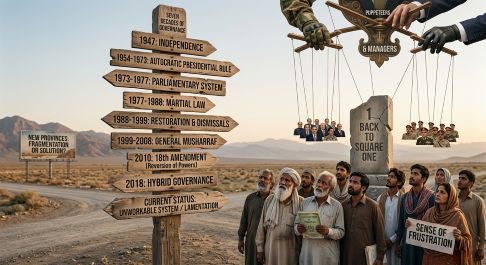
The managers will remain unchanged. Some weak persons would be put at the head, vulnerable to manipulation and control. The establishment will maintain this political charade for some years, with the small federal constituents engaged in a nation-wide campaign for the reunification of their severed parts.
Click here for Part-1, Part-2, Part-3
_________________
 The writer is a former member of the Foreign Service of Pakistan and has served as Ambassador for two terms. He is the author of five books.