The Visual Language Explored
The Relationship between Symbol and Doctrine in the Visual Arts


An artwork is not merely a record of reality; rather, it is a form of expression of it.
Souad Khalil | Libya
What distinguishes human beings is their ability to express their emotions in material form, which is considered both a practical and a spiritual need. Since folk arts and their history are closely connected to the authenticity and life of peoples, and especially of artists, the symbol becomes the medium through which these meanings are expressed over time and historically, allowing a deeper understanding of these arts. It represents the form and significance that gives rise to every sensation along with its symbolic twin within a society rich with cultural and social values, summarizing its beliefs and ideas through human feelings and emotions, and adding to them years of work and experience.
Dr. Saeed Sayed Al-Wutairi states in this regard:
“If form and content constitute an organic unity left by art, they emerge in the artist’s thought and sentiment, driven by sensation and the impulse to create, as a result of lived experience, immersion, and the struggles of experimentation, shaping the artwork in accordance with the artist’s alignment with the era, time, and society.”
From a purely artistic perspective, the symbol is a distinctive language reflecting a particular society with all its refined cultural values, unique to the people who created it. It expresses their historical legacy and extends that heritage, translating these features into the available tools and means of artistic expression. In doing so, it serves as a true translation of the language used by folk artists to express their own feelings and the feelings of their community, encompassing beliefs, ideas, and concepts.
 An artwork is not merely a record of reality; rather, it is a form of expression of it. However, the fact that an artwork does not directly record reality does not mean that it is entirely disconnected from it, as is the case with practical symbols. Instead, it represents reality in an abstract form, derived from transient phenomena limited to specific times and places. In this sense, the artwork is not reality in its particular form, but reality in its general form, which transcends both time and place.
While art in this sense is tangible yet abstract, science also relies on abstract conventional symbols. The difference lies in the fact that the scientist, in the course of their work, is concerned only with specific observable phenomena, then applies these phenomena across different contexts using specialized conventional symbols, thereby producing abstract values far removed from tangible reality.
The artist is often a sensitive individual, deeply affected by color values, the relationship between forms, the repetition and modulation of sounds, and the texture and variations of objects. Practical or material value rarely concerns them. The values blended in their works are purely sensory and abstract. During creation, the artist begins with tangible reality but gradually abstracts it from its specific appearances, ultimately producing something that is not literal reality, yet remains connected to it. Artistic symbols are not reality; at the same time, they are intimately related to it—they are abstract sensory symbols.
Art as More Real than Reality
On one hand, the abstract sensory nature of artistic works renders them more “real” than tangible reality. Objectively, an artwork may represent truth, but subjectively, it conveys only a part of it. The partial does not necessarily represent the whole, and the particular does not always convey the universal. Art becomes more “real” than perceived reality when it contains multiple meanings within seemingly simple forms.
The Abstract Aspect
Abstraction relies entirely on visual recording. An artist may start with natural forms, which gradually become lines and shapes interconnected, yet distanced from their original natural appearance. Abstraction is an attempt to summarize and reveal the laws of form with the fewest lines and simplest possible shapes. In ancient works, for instance, hieroglyphic writing—such as depictions of the Nile and water as the key of life, or the falcon—demonstrates how the Egyptians abstracted shapes from nature and applied them in new writing contexts to convey new meanings.
 Similarly, in Coptic art, the use of a lion’s head and a human body represented a war machine. Symbols such as the fish, cross, dove, lamb, eagle, sword, and key were all used to express specific meanings. Likewise, Islamic artists used geometric patterns and repetitive plant motifs abstracted from nature, often integrated with calligraphy as an essential aspect of artistic composition. Another form of abstraction treats form itself as a language capable of expressing artistic meanings without relying on natural originals. Artists manipulate forms, colors, and spaces based on their capacity to convey meaning, just as musical tones evoke emotion independently of external reality. These symbolic meanings remain in use today: for example, the dove represents peace, and the eagle represents power. The symbolism reflects the reductive process inherent in writing.
Characteristics of Symbols
Given the importance of symbols, it is essential to understand their characteristics, artistic and social values. Symbolism may express a distinctive idea or record facts in abstract form. In general, symbolism is a form that encompasses experience, whether simple or complex, intrinsic to the object itself, not external to it.
The Artistic Symbol
It is the unit or decorative form inspired by the environment, which forms the foundation of the artwork produced by the folk artist. Through their work, the artist achieves a distinctive and expressive style, reflecting the values, beliefs, traditions, and culture of their environment, which interacts with the broader human context. Although external appearances may vary and evolve, what the folk artist observes and engages with ensures the success of their artwork. Their rootedness in their environment, combined with their interpretation of it and the perspectives it provides, allows them to communicate their vision effectively, connecting those around them to that vision through their understanding, love, and study of the environment, as well as their mastery of visual language, simplicity of execution, and ability to express their individuality freely.
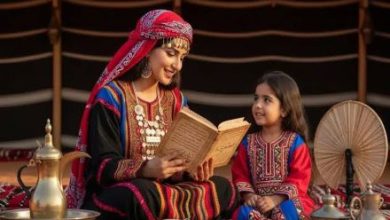
 The folk artist is endowed with a spirit of freedom, enabling them to express their status and personality beyond innate tendencies. This extends to beautification in their work, preserving their emotional history while remaining connected to inherited traditions and social customs. They express this through various arts and crafts, manifesting their imagination and perceptions of life across two worlds: that of humans and animals, or humans and spirits. Traditional practices, such as embroidery, buttons, and geometric patterns, carry spiritual significance. For example, dots symbolize stings, lines represent life, triangles symbolize protective veils against evil, and repeated shapes express protective gestures.
Tattoo Symbols among the Bedouins and Their Social-Historical Significance
Tattoo symbols used by the Bedouins on their camels, horses, and possessions hold significance similar to tattoos on their bodies, reflecting careful attention to traditional handicraft practices and their social-historical meanings. Tattoo symbols differ between tribes and subgroups, ranging from simple vertical or horizontal lines, diagonals, arrows, circles, triangles, and crosses, to more complex composite forms. Each unit has a specific name, reflecting the object it symbolizes or the placement of the tattoo. Eastern Bedouins in Sinai and the northern Red Sea Governorate use different symbols from western Bedouins in Matrouh and the New Valley, or from southern Bedouins in Aswan and southern Red Sea. Within a single tribe, even with different subgroups, a unified symbol is often adopted to reinforce ownership or familial bonds, regardless of geographical separation.
Read: Globalization and the Visual Arts
___________________
 Souad Khalil, hailing from Libya, is a writer, poet, and translator. She has been writing on culture, literature and other general topics.
All images provided by the author