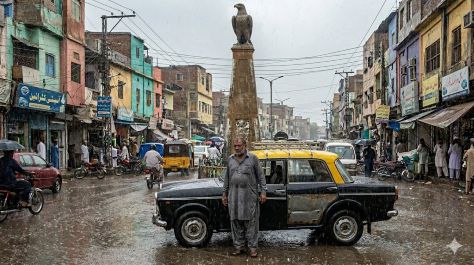
Stories of Karachi’s Taxi Drivers from 1993 to 2000
Zaffar Junejo
[Author’s Note: I joined a non-government organization in mid-1993. In those days, we were frequent travelers to other Asian countries, and during that period I maintained a diary. I once showed the notes to Muhammad Ibrahim Joyo — the legendary scholar, translator, and intellectual giant of the Sindhi world — who suggested categorizing the entries by theme and getting them published. He recalled that long ago, perhaps in 1955, the Sindhi journal Mehran had launched a similar idea titled ‘Hik Deenh Ji Ghaleh’ (The Story of a Day), even offering a prize for it. He himself had submitted the first story, he told me with a smile, just to set a standard for other writers. Later, Maulana Ghulam Muhammad Girami, a scholar of high standing and journalist; Shamsher ul Haidri, a distinguished Sindhi poet, journalist, and playwright; and Siraj ul Haq Memon, an iconic novelist, linguist, and journalist, all contributed their observations of a single day. These writings were published until 1968.
I agreed with Joyo Sahib that I would group the write-ups by subject and get them published, but I failed to do so. Recently, I sat down to organize my notes. I found various entries about the taxi drivers of Karachi city. Some were very brief and incomplete; others were short but held a finished truth. I have chosen five stories from each year, all of them gathered from the drivers of those cars. In total, there will be thirty-five stories covering the period from 1993 to 2000.
On the surface, these pieces appear to be simple narratives. However, beneath the prose, they depict the complex socio-political and cultural landscape of Karachi during those turbulent days. They are the echoes of a city in motion.]
The Men with Badges
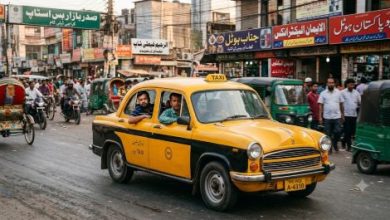
The first winter shower washed the dust from Cheel Chowk. Drops splattered against the rusted metal of an old taxi. The driver stood by the door. He was thickset, heavy-shouldered, with lines cut deep into his face. He looked at the sky, then at the road.
I raised my arm and motioned toward Gulshan-e-Iqbal.
The old man opened the rear door. He climbed into the front seat, gripped the cracked steel steering wheel, and cleared his throat. The engine caught with a low, wet roar.
The cab interior felt safe from the damp chill outside. Heat rose from the floorboards. The driver shifted into first gear, his eyes tracking the mirrors. He leaned back, catching a glance in the rearview mirror.
“Sindhi?”
A nod from the back seat.
The driver tapped the dashboard with a thick index finger. “The Urdu gives it away. Every time.”
The tires splashed through oily puddles along the Lyari lanes. Smoke rose from roadside tea stalls.
“You have driven this city a long time.”
The old man looked at the road. “Since the time of General Zia.”
The car hit a deep trench in the asphalt, bouncing heavily. The chassis groaned.
“The roads are bad for the suspension.”
“Every neighborhood has its own curse,” the driver said, his voice flat like the road. “A Lyari man has his troubles. A Lalukhet man has others.” He shifted to third gear. “Fuel costs money,” he muttered, counting off on his calloused thumb. “The traffic police wait at the circle. The potholes break the axle. The street boys look into the window at the red lights.”
Silence settled inside the warm cabin. Rain streaked the side windows, blurring the concrete buildings of Karachi. The windshield wipers clicked a steady, slow rhythm.
“The parties change things,” the old man spoke up, eyes fixed on the brake lights ahead. “Under the Peoples Party, the traffic police get hungry. They pull you over for nothing. They want the bribe. They threaten to take the license.” He swerved around a stalled, rickety bus.
“And the other times?”
“When the MQM held the sectors, the streets went dark,” he said, his knuckles turning white on the wheel. “The signals stopped working. Men appeared from the shadows. They demanded the toll. They burned the cars if you did not pay.” He shook his head, looking at the gray sky through the glass.
“How does it end?”
The driver tapped his shoulder, right where the brass stars sit on a uniform. “Both parties serve the same masters. The ones with the badges.”
The car slowed near the university campus. The traffic became a solid wall of metal and smoke.
“Three things can happen,” the old man said, staring at the gridlock. “The city runs completely dry. Nothing left to steal or grab. Or the people burn the offices down.” He paused, shifting back to second. “But the drivers will not do it. The Pathans, the Multanis, the Afghanis, the Bengalis—they make their own deals. No one stands together.”
The taxi turned onto the wider avenue, nearing the gray concrete structures of Gulshan.
“You speak like a comrade.”
The old man let out a short, dry laugh. He reached into his vest pocket, pulling out an old, faded plastic card before revealing it in his palm and tucking it back. “I am a worker for the party. Not the new ones. Not Zardari. I belong to the old ideology. Bhutto’s man.”
The car pulled up to the curb, right across from the Auditor General’s Office. The brakes squealed, then went still.
Seven hundred rupees changed hands.
The old man took the paper notes. He did not count them. He folded the money once and slipped it deep into the front pocket of his kameez, nodding once into the mirror as the door clicked shut.
***
The Rest on the Dirt
The autumn wind blew cold leaves across Tariq Road. Dust settled on the bricks of the old cemetery down the lane. The yellow trees dropped their final leaves onto the cracked pavement.
My friend walked back toward his new office on foot. The street was short, and his shadow stretched long under the pale afternoon sun. I turned and walked the opposite way, looking for a ride through the haze.
A taxi sat by the curb. The engine idled with a low, rhythmic rattle. The driver sat straight inside the dim cabin, staring at the crowded street ahead. I bent near the window and tapped the glass.
“Saddar?”
The man waved his hand toward the back seat with a quick, silent motion. The door opened. I got inside, and the smell of cheap tobacco filled my lungs.
The taxi shifted gears with a heavy clunk. The tires rolled past the white dome of Jinnah’s Mausoleum, which stood cold against the gray sky. The driver gripped the steering wheel with tight, white knuckles. His shoulders remained stiff, locked in deep frustration.
I leaned forward slightly. “A long day?”
“A bad day.” The driver stared straight through the windshield. He tapped the plastic dashboard with his knuckles, his fingers trembling slightly. “I drive from dawn until the streetlights come on. Five times today I stopped in the markets. Six times today a man with a ‘parking-fee-receipt-book’ came and asked for the fee, just to let the wheels rest on the dirt.”
He watched the road ahead, his eyes fixed on the brake lights of the cars before us.
“The parking fee in total takes two hundred rupees every single day,” he said, slapping the steering wheel. “The engine burns petrol. The tires wear down to the bare wires on these broken roads. A poor man cannot keep his food money when every corner has a parking-fee book.”
I nodded, looking out at the passing shops. “The parking fees are high.”
“The district Nazims make the parking zones to rob us.” The driver swerved to avoid a pothole. “It is extortion by rule. This country stays together because the corruption runs deep and connects every office. The day justice arrives, the whole machine will break.” He steered through the heavy, lawless traffic. “People know no other way.” His shoulders finally slumped against the seat. “They accept the theft because they never saw a land with real law.”
The car slowed near the crowded shops of Regal Chowk. The brakes squealed loudly on the road.
I reached for my wallet. “How much?”
“Two hundred and fifty.” He extended his right hand backward without turning around.
I put the notes in his open palm. I bolted out into the crisp, smoke-filled air, and the taxi disappeared into the sea of vehicles.
__________________
 Dr. Zaffar Junejo has a Ph.D in History from the University of Malaya. His areas of interest are post-colonial history, social history and peasants’ history. He may be reached at junejozi@gmail.com