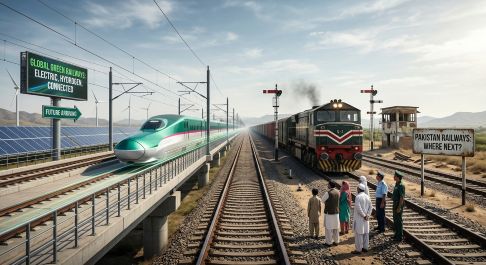
The World Is Racing Towards Fast and Green Railways. Where Is Pakistan?
- The railway of tomorrow will be electric, hydrogen-powered, battery-assisted, digitally controlled and increasingly connected to renewable energy.
- The world is building the railway of tomorrow. Pakistan must decide whether it will board that train, or continue watching it pass.
By: Ramesh Raja
The world is undergoing a profound transformation in the way it thinks about transportation. As climate change accelerates, cities become increasingly congested, energy security becomes a strategic concern, and carbon emissions demand urgent action, one of the oldest forms of transport is emerging as a defining technology of the future: the railway.
Across continents, countries are no longer content with conventional locomotives and ageing tracks. They are reinventing railways with faster, cleaner, smarter and increasingly energy-efficient trains, powered by electricity, hydrogen and batteries. Some are pushing conventional high-speed rail towards 300–400 km/h and beyond, while others are replacing diesel trains with hydrogen fuel cells on non-electrified routes.
From China’s ultra-fast electric trains and Japan’s next-generation rail technology to India’s newly launched hydrogen train and Europe’s growing fleet of clean-energy trains, the railway revolution is no longer a vision of the future; it is happening now.
And as the world accelerates towards a new era of sustainable mobility, one question becomes increasingly difficult to ignore: while the world is reinventing the railway, where is Pakistan?
The world is witnessing an extraordinary new era of railway innovation, with countries rapidly developing and introducing faster, smarter and cleaner trains powered by green energy and designed to reduce, and in many cases virtually eliminate, carbon emissions.
Read: Chinese bullet train breaks acceleration world record
From high-speed electric trains increasingly powered by renewable electricity to hydrogen fuel-cell and battery-electric trains replacing diesel locomotives, railway technology is advancing at remarkable speed. Some of the most significant and recent examples from around the world are discussed below.
India: Hydrogen Has Arrived
India has provided perhaps the most striking recent example.
On 17 July 2026, India launched its first domestically developed hydrogen-powered passenger train between Jind and Sonipat in Haryana. The train uses hydrogen fuel-cell technology to generate electricity onboard, with water vapour as the only direct by-product. India has thereby joined the select group of countries with operational hydrogen-powered passenger trains.
The train is not a 300 km/h high-speed train. Its importance lies elsewhere. It is designed to demonstrate how hydrogen can replace diesel on non-electrified railway lines, without requiring continuous overhead electrification.
The development is already moving beyond a single train. Recent reports indicate that Indian Railways is considering an expansion to 35 hydrogen trains, while exploring ways to reduce the cost of green hydrogen.
India is therefore simultaneously expanding conventional rail, high-speed rail and new clean-energy propulsion.
China: From 400 km/h to Hydrogen
China is operating on an entirely different scale.
Its railway strategy combines an enormous existing high-speed network with the development of the next generation of trains.
The CR450 is designed to operate at around 400 km/h, potentially making it the world’s fastest conventional high-speed train. In August 2026, its prototypes completed a 600,000-kilometre operational test, moving the train closer to final inspection and certification.
This is an electric train, not a hydrogen train. That distinction is important. For high-speed corridors, direct electric propulsion remains the dominant technology because of its efficiency and power requirements.
At the same time, China is developing hydrogen-powered trains for routes where conventional electrification may not be economical.
China is therefore pursuing both ends of the railway energy revolution: ultra-fast electric trains and cleaner alternatives to diesel.
Japan: Hydrogen and Ultra-High-Speed Maglev
Japan is another country where railway technology has two faces.
At the regional level, Japan has been testing the HYBARI FV-E991, a hydrogen-hybrid train combining hydrogen fuel cells with batteries. The project began testing in 2022, with a maximum speed of around 100 km/h.
But Japan’s most spectacular railway technology is its maglev system.
Unlike conventional trains, maglev uses magnetic levitation and electric propulsion. Testing has reached speeds of around 600 km/h, placing Japan at the extreme end of passenger rail technology.
Japan’s message is clear: the future of rail is not simply about improving the diesel locomotive. It is about fundamentally changing how trains are powered and how they move.
Germany: Replacing Diesel with Hydrogen
Germany was an early pioneer of hydrogen passenger trains.
The country introduced hydrogen trains into passenger service in the Elbe-Weser region in 2022. Newer Mireo Plus H trains are now being introduced for regional services.
In Bavaria, Siemens and SüdostBayernbahn presented the Mireo Plus H in July 2026. Testing and driver training are underway, with regular service planned from December 2026 on the Mühldorf–Burghausen route. The trains are intended for non-electrified routes and use hydrogen fuel-cell technology.
Germany demonstrates an important application of hydrogen: it can provide zero local-emission traction without immediately electrifying every kilometer of railway.
France: The Next Generation of TGV
France is taking a different route.
Its railway revolution remains overwhelmingly electric.
The new TGV M, the fifth generation of France’s famous TGV high-speed trains, has received European marketing authorization and is scheduled to welcome its first passengers in early September 2026.
The TGV M is designed for high-speed operation of around 320 km/h, while incorporating improvements in energy efficiency, passenger capacity, accessibility and recyclability.
France therefore provides another important lesson:
A green train does not have to be a hydrogen train.
A highly efficient electric train powered by a low-carbon electricity system can be one of the cleanest forms of mass transportation.
Italy: Hydrogen for Regional Rail
Italy is also moving into hydrogen railway technology.
The country’s Coradia Stream H program is designed to replace diesel trains on non-electrified regional routes. The hydrogen train belongs to Alstom’s Coradia Stream family and has been designed for speeds of approximately 140 km/h. Italian authorities have recently moved closer to allowing hydrogen trains to operate on the Brescia–Iseo–Edolo line.
The Italian model is particularly relevant for countries with extensive non-electrified railway networks.
Instead of spending enormous amounts immediately on electrifying every route, hydrogen can potentially provide a transition from diesel to cleaner propulsion.
Switzerland: Hydrogen Meets Difficult Terrain
Switzerland, through companies such as Stadler, has also been developing hydrogen-powered trains.
The Swiss approach is particularly interesting because its railway network includes mountainous terrain, regional routes and narrow-gauge lines, where railway engineering requirements can be very different from those of a flat high-speed corridor.
Hydrogen trains are being investigated as a way of providing clean propulsion where conventional overhead electrification is not always the most practical solution.
Spain: Hydrogen for the Non-Electrified Network
Spain already possesses one of Europe’s largest high-speed electric railway networks, but it is also developing hydrogen technology for non-electrified routes.
The objective is similar to Germany and Italy: use hydrogen fuel cells to replace diesel traction where complete electrification is difficult or economically unattractive.
Spain’s experience shows that a country does not have to choose between high-speed electric rail and hydrogen rail. Different technologies can coexist for different transport requirements.
United States: A Different Starting Point
The United States has historically depended heavily on diesel-powered rail, particularly outside its electrified corridors.
California has therefore become an important testing ground for hydrogen passenger trains. The FLIRT H₂, developed by Stadler, combines hydrogen fuel cells with batteries and is designed for regional passenger service at speeds of roughly 130 km/h.
The American objective is not necessarily to compete with China’s 400 km/h trains.
It is to find practical ways of replacing diesel while avoiding the enormous cost of electrifying every route.
South Korea: Hydrogen Alongside High-Speed Electric Rail
South Korea is also pursuing hydrogen railway technology while operating an advanced electric high-speed railway system.
Hydrogen projects are aimed mainly at replacing diesel on non-electrified routes. At the same time, the country’s KTX high-speed railway demonstrates how electricity remains the dominant technology for high-speed intercity transportation.
South Korea is therefore following the same broader global pattern:
electricity for high-speed corridors, hydrogen and batteries for routes where conventional electrification is less practical.
Britain: Batteries, Hydrogen and Electrification
The United Kingdom is also examining alternatives to diesel through hydrogen and battery-electric trains.
The country has tested hydrogen demonstrators such as HydroFLEX and continues to explore battery technology for partially electrified routes.
The British challenge is somewhat different. Its priority is not simply building a new generation of trains, but also expanding electrification, improving capacity and modernizing an already heavily used railway network.
What is actually happening in the world is far more significant than simply a race to build faster trains. There is no single green train of the future; rather, several different railway technologies are emerging to meet different transport and energy needs.
Electric high-speed trains are being developed for major intercity corridors, reaching speeds of 250, 300, 350 and even around 400 km/h. Hydrogen-powered trains are being introduced primarily on non-electrified regional routes as a cleaner alternative to diesel. Battery-electric trains are becoming increasingly attractive for shorter routes and railway sections where full electrification may not be economically justified, while maglev technology is pushing the boundaries of ultra-high-speed travel.
At the same time, these railway technologies are becoming increasingly integrated with the wider global energy transition through solar, wind, hydropower, energy storage and green hydrogen.
The railway of the future, therefore, is no longer simply about locomotives, tracks and speed. It is about clean energy, climate action, advanced technology, sustainable mobility, energy security and national economic strategy.
Pakistan: From ML-1 to a National Railway Vision
Pakistan is not entirely absent from the global railway transformation. The Main Line-1 (ML-1) modernization project aims to transform the principal Karachi–Peshawar railway corridor, with the first phase focusing on approximately 480 km between Karachi and Rohri/Sukkur, targeted for commencement in January 2027. The upgraded corridor is expected to support speeds of up to 160 km/h, significantly improving passenger and freight movement.
Yet the gap is clear: while Pakistan is preparing for 160 km/h, China is moving towards 400 km/h, France is introducing its new-generation TGV M, India has launched a hydrogen-powered passenger train, and Germany is expanding hydrogen rail.
The issue is not whether Pakistan should copy these technologies, but where it wants its railway to be in 2030, 2040 and 2050.
Pakistan Needs a Railway Vision, Not Just a Railway Project
ML-1 should therefore be treated as more than a track-modernization project. It should become the foundation of a National Railway Transformation Strategy, examining progressive electrification, battery-electric and hydrogen trains, renewable-energy integration, modern signalling, AI-based maintenance and genuine high-speed passenger corridors where demand justifies them.
Freight should increasingly move from highways to efficient rail, while Karachi Port, Port Qasim and Gwadar should be connected with modern freight corridors. Railway stations should become multimodal hubs linking trains with buses, roads and future electric mobility.
Pakistan has the engineering talent to build modern railways. The real challenges are continuity of policy, financing, institutional capacity, project preparation and execution.
Railways and highways should not compete; they should form an integrated multimodal transportation network, with each mode carrying the traffic for which it is most efficient.
Pakistan sits between China and India, two of Asia’s most ambitious railway powers. China is pushing towards 400 km/h, India has entered the hydrogen era, France is introducing a new generation of high-speed electric trains, Germany is expanding hydrogen rail, and Japan continues to pursue ultra-high-speed maglev.
Pakistan need not copy every technology, but it must match the ambition and long-term vision of the changing world.
The railway of tomorrow will be electric, hydrogen-powered, battery-assisted, digitally controlled and increasingly connected to renewable energy. Pakistan’s 160 km/h ML-1 modernization is an important beginning, but it cannot be the final destination.
The world is building the railway of tomorrow. Pakistan must decide whether it will board that train, or continue watching it pass.
Read: Bridges Built for Decades, Failing in Years
_________________
 The author of this article, Engr. Ramesh Raja, is a Civil Engineer, visionary planner, PMP certified and literary enthusiast with a passion for art and recreation. He can be reached at engineer.raja@gmail.com