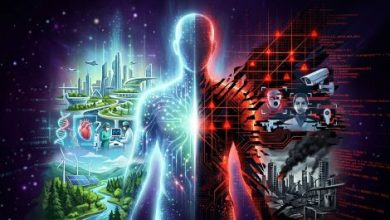
The AI utopia depends on more than what machines can do. It depends on who owns them, who benefits and whether institutions protect people through change.
By Ramesh Raja
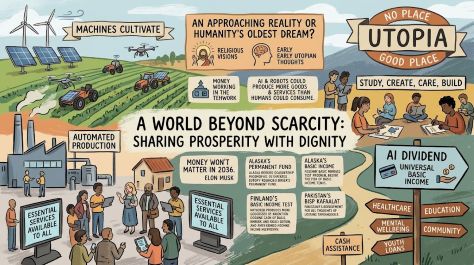
Imagine a morning when nobody fears losing a livelihood. Machines cultivate the fields, factories operate with minimal supervision, and essential services remain available even to those without employment. People still study, create, care and build, but hunger no longer compels them to sell their time. Is this an approaching reality, or humanity’s oldest dream wearing the clothes of artificial intelligence? On 29 October 2026, Business Insider reported that “Elon Musk had dismissed saving for the distant future”, echoing his earlier declaration in an interview with The Economist: “Money won’t matter in 2036.”
Long before computers, people imagined existence beyond scarcity and exhausting toil. In Islam, the Quran describes the Garden as a place without hunger or nakedness (20:118), and the everlasting dwelling as free from fatigue and weariness (35:35). Christianity offers a related image in Revelation 7:16–17: hunger and thirst cease, and tears are wiped away. These passages express a profound hope for freedom from deprivation and suffering.
Hindu traditions also describe heavenly enjoyment, although they distinguish it from final liberation. The Bhagavad Gita, 9:21, explains that those enjoying heaven return to the mortal world when their accumulated merit is exhausted. Heavenly pleasure, in this account, is temporary. These religious visions have different spiritual meanings and cannot be reduced to economic programs. Yet they reveal how deeply humanity has longed for an existence relieved of hardship.
In 1516, the English humanist Thomas More gave an imaginary society a lasting name: Utopia. Written in Latin and first published in Leuven, in present-day Belgium, the book described an island organized differently from contemporary Europe. Its name combines Greek elements meaning “no place”, while echoing “a good place”. The word captures the tension between an ideal society and one that may exist nowhere.
More’s island, however, was no world of universal idleness. Its inhabitants generally worked six hours daily. Shared provision and the organization of useful work were intended to reduce excessive toil. Moreover, the society included slavery and other coercive practices, making it unsuitable as a modern blueprint for equality. Its enduring contribution was to ask whether human institutions could distribute work, resources and leisure differently.
Five centuries later, Elon Musk has attached a technological timetable to the dream of abundance. In an interview with The Economist’s editor-in-chief, Zanny Minton Beddoes, at Tesla’s Texas Gigafactory, he declared: “Money won’t matter in 2036.” The podcast edition was released on 23 July 2026, although that release date should not be confused with a confirmed recording date.
His reasoning was straightforward: AI and robots could eventually produce more goods and services than humans could consume. If food, housing, transport and entertainment became sufficiently abundant, he argued, money would lose its importance. On 29 October 2026, Business Insider also reported an X post in which Musk dismissed saving for the distant future because of approaching “super intelligent abundance”. These are ambitious predictions, dependent on technological progress and economic arrangements that have yet to be demonstrated.
Yuval Noah Harari had examined many of the underlying questions in his 2018 book, 21 Lessons for the 21st Century. Chapter 2, “Work: When You Grow Up, You Might Not Have a Job”, considers how AI and robotics might displace workers and force people to retrain repeatedly. He warns of a possible class whose labor the economy no longer requires. His provocative expression “useless class” concerns economic demand, not human worth.
Harari discusses universal basic income and universal basic services as possible responses. His caution is crucial: greater production does not automatically produce a fair society. Even when basic needs are met, competition may shift towards scarce luxuries, superior medical treatments and opportunities. People also need purpose, recognition and community. Material security alone cannot answer every human need.
Research suggests substantial disruption, although it does not establish that employment is about to disappear. On 14 January 2024, the International Monetary Fund reported that almost 40 per cent of global employment was exposed to AI, rising to about 60 per cent in advanced economies. Exposure includes jobs that AI could complement as well as those facing reduced demand. An engineer assisted by AI and a worker replaced by automation represent different outcomes within the same technological transformation.
Meanwhile, partial examples of life supported beyond current wages already exist. On 14 August 1935, US President Franklin D. Roosevelt signed the Social Security Act, establishing a framework for old-age benefits, unemployment insurance and assistance to vulnerable groups. Social insurance and public assistance differ: some benefits depend on contributions, others on need. Together, they demonstrate that protection need not depend entirely on a person’s immediate ability to earn.
Alaska offers another useful example. Its Permanent Fund Dividend distributes a share of public investment wealth to eligible residents. The 2025 payment was US$1,000 per person. This was supplementary income rather than a complete livelihood, but it illustrates an important principle: people can benefit from shared assets without personally working for each payment. An AI dividend could apply a comparable principle if citizens held a share in automated productive wealth.
Finland tested unconditional basic income between January 2017 and December 2018. Two thousand unemployed people received €560 monthly, regardless of whether they sought or obtained work. The evaluation found small employment effects alongside better perceived financial security and mental wellbeing. Finland did not become a country without work. It tested whether less conditional support could improve people’s lives.
Pakistan, too, has practical beginnings of this discussion. The Benazir Income Support Program was initiated in 2008. Its Kafaalat component provides targeted cash assistance to eligible women. From January 2025, the quarterly payment increased from Rs10, 500 to Rs13, 500, equivalent to Rs4,500 monthly. This dated figure illustrates both the importance and modest scale of such protection; it should not be read as the current payment rate.
What people commonly call a Benazir card represents an entitlement delivered through a payment system. The card itself creates no wealth. The underlying principle is collective responsibility for vulnerable households. Youth programs may serve a different purpose. Pakistan’s Prime Minister’s Youth Business and Agriculture Loan Scheme, for example, offers credit to support enterprise. A repayable loan helps someone establish a livelihood; it is not an unconditional income. Welfare payments, healthcare benefits, scholarships and youth loans should therefore be distinguished even when accessed through similar cards or digital platforms.
Could these arrangements expand until paid employment becomes optional? Possibly, but production and distribution would have to develop together. Governments might combine basic income, publicly funded services, shorter working hours and dividends from public investments. They would not necessarily provide every desired item free. A more practical ambition would be dependable access to necessities, with additional consumption supported through earnings, savings or dividends.
The funding question remains decisive. If machines replace a substantial share of paid labor, revenue systems heavily dependent on wages would face pressure. Governments would need effective ways to collect revenue from profits, capital income, consumption or publicly owned investments. Printing money alone cannot produce houses, electricity or food. Financial support must be matched by available goods and functioning services.
Nor can intelligence abolish every physical limit. Desirable land, freshwater, minerals and energy remain constrained. A robot may help construct a home, but it does not automatically secure land, water connections, planning approval or affordable electricity. For Pakistan, reliable power, education, digital access and capable institutions would be foundations of any broadly shared AI prosperity.
The transition deserves as much attention as the destination. Workers could lose income before replacement opportunities or adequate support arrive. A country importing AI services might suffer disruption while collecting little of the resulting profit. National welfare systems would struggle if technological wealth accumulated elsewhere while their own tax bases weakened.
Even successful material provision would leave a human question. Employment offers structure, companionship, recognition and identity as well as wages. Freedom from compulsory employment could create more space for art, research, caregiving, civic service and spiritual life. These activities still require effort. A worthwhile future would allow more people to choose that effort without fear of destitution.
The AI utopia therefore depends on more than what machines can do. It depends on who owns them, who benefits and whether institutions protect people through change. Religious traditions imagined relief from suffering; More explored a different social order; Harari examined technological displacement; Musk predicts extraordinary abundance. Turning any material part of that promise into everyday life will require an achievement as demanding as the technology itself: sharing prosperity with dignity.
Read: Extend Expressways on Lyari and Malir Rivers
___________
 Hailing from Gambat town of Sindh, Engr. Ramesh Raja, is a Civil Engineer, visionary planner, PMP certified and literary enthusiast with a passion for art and recreation. He can be reached at engineer.raja@gmail.com