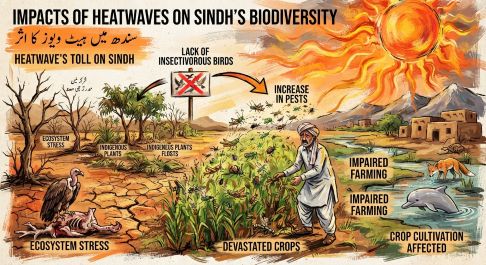
The interaction between heatwaves and biodiversity constitutes a substantial environmental issue.
- Apart from directly harming flora and fauna, high temperatures can also impair natural environmental processes.
- The lack of insectivorous birds and natural flora can exacerbate farming insect problems. This can then impact upon the cultivation of crops.
Mir Mohammad Junejo
Sindh experienced repeated episodes of extreme temperatures throughout 2026, highlighting the province’s increasing exposure to heat stress and climate-related risks. According to reported Pakistan Meteorological Department (PMD), the temperature in Mithi, District Tharparkar, and Shaheed Benazirabad reached 40.5°C on 10 March 2026, indicating an unusually early onset of intense heat. Temperatures further intensified during May, when Dadu recorded the year’s highest reported temperature in Sindh, reaching 51.5°C on 28 May 2026, surpassing its previous record of 51.4°C recorded on 18 May 2016. The extreme heat was also reported in other parts of upper Sindh, including Jacobabad and Larkana. Notably, elevated temperatures persisted into November, with Mithi and Chhor recording 37.5°C on 11 November 2026. These observations demonstrate that unusually high temperatures affected Sindh from March through November, representing an extended period of seasonal heat exposure rather than a single continuous heatwave. The prolonged occurrence of extreme heat conditions poses significant challenges for vulnerable communities, particularly in rural areas, where agricultural workers, livestock, women, children and older people face increased risks of heat-related illness, water scarcity, reduced agricultural productivity and livelihood insecurity.
As well as impacting upon people, farming and livestock, prolonged high temperatures are also impacting upon biodiversity and the equilibrium of natural environments. Although typically the human, farming and livestock impacts of high temperatures are recognized and analyzed, there is generally less focus on the impact that high temperatures have on birds, insects, reptiles, water life and on flora and fauna within forests and along coastlines. Poor biodiversity as a result of high temperatures can, in turn, cause further environmental problems. These can then impact on farming, fisheries and the livelihoods of rural and coastal communities. Birds are highly susceptible to high temperatures. Drought, high temperatures, diminishing water supplies and poor food and habitat provision can all impact upon birds’ health, behavior and ability to reproduce. Birds utilize wetlands, farmland, riverine forest, grassland and mangroves for food and shelter. During periods of extreme heat, pond and wetland water sources can evaporate. Simultaneously, food supplies within water sources can be negatively affected and vegetation can wither. Birds may therefore need to relocate and can also suffer from dehydration and heat related health issues as a result. Peacock deaths were reported in Tharparkar during Sindh’s 2025 heatwave to emphasize the impact that high temperatures can have on Sindh’s wildlife.
Beyond individual birds, birds provide valuable environmental benefits. For instance, they can help to control insect numbers and are integral in food chains. There are numerous insectivorous birds, such as swallows, bee-eaters and drongos that extensively consume various types of insect – some of which can be harmful to farming. Consequently, if high temperatures, habitat loss and/or water supply issues cause a decrease in bird populations, natural insect control mechanisms can also be negatively impacted. Provided environmental conditions are appropriate, some insect and harmful species can then proliferate and may cause further damage to farmland, fruit trees, native and other plant life. Greater reliance on artificial farm insecticides may then be required. In so doing, not only are farmers facing increased farming expenditure, but also risks to advantageous insects, soil and water quality and to human health can arise.
Keenjhar Lake in Thatta, Manchar Lake in Dadu and Chotiari Reservoir in Sanghar are key examples of water bodies that benefit biodiversity. They sustain diverse species such as resident and migratory birds, fish, amphibians, reptiles and further wildlife. Nevertheless, during extended periods of high temperatures, water levels within these water bodies can fall and the water can become warmer and less rich in oxygen. Alongside this, water sources can evaporate, further compromising the environment. Unsuitable water bodies for feeding, resting and reproduction can then cause birds and other wildlife to relocate or to experience poorer reproductive outcomes. According to a Sindh waterfowl survey undertaken in 2024-25 by the Sindh Wildlife Department, the number of migratory birds in Sindh fell considerably between 2023 and 2024-25; dropping from approximately 1.2 million to 545,258. Key concerns highlighted in the survey included water supply, together with poor and deteriorating wetland and habitat quality. Although this is not solely attributable to heatwaves, the findings illustrate how a combination of climatic and environmental factors are increasingly impacting upon Sindh’s avian biodiversity.
Consequences can also be seen for reptiles, and snakes in particular, and further wildlife as a result of a decline in bird numbers. Birds of prey are natural predators of small animals and reptiles and many bird species will also consume insects, amphibians and smaller creatures. Thus, if extended periods of high temperatures and/or habitat loss cause a decline in birds, this can disrupt natural food chain dynamics. Subject to environmental factors, specific animals and/or insects may then proliferate. Alterations in food sources can also impact the numbers and geographical spread of snakes and lizards. Moreover, increased insect numbers can offer further sustenance for some insectivorous reptiles and thus impact upon local environmental dynamics. However, it is not guaranteed that snake numbers will necessarily rise simply because of fewer birds. Snake population size will depend on a range of variables, including prey numbers, environmental factors, temperature and the presence of other predators. As demonstrated, the impact of a decline in one section of biodiversity can then affect wider environmental dynamics.
The coastal areas of Thatta, Sujawal and Badin are similarly greatly affected by high temperatures. Alongside freshwater scarcity, rising salinity and altered coastal characteristics, sustained periods of high temperatures are exerting further strain upon the environmental quality of, for example, the Indus Delta’s mangroves, tidal channels, mudflats and estuaries. Mangroves, predominantly comprising Avicennia marina, are critical for the reproduction and rearing of fish, shrimps and crabs. Alongside this, they are also key habitats for resident and migratory birds, reptiles, insects and other wildlife. Prolonged high temperatures, along with water scarcity and salinity can all affect mangrove re-growth and vegetation health. Further deterioration of mangroves can then compromise fish and shrimp breeding sites and additionally impact upon biodiversity. Fishing communities can in turn be negatively affected as a result. The Sindh Forest Department recognizes the mangroves of the Indus Delta as key habitats for a wide variety of species, as well as being of great importance to the coastal communities’ livelihoods.
In coastal areas, biodiversity is not just an environmental concern – it is also intrinsically linked to people’s economies and food supplies. Poor mangrove and aquatic biodiversity can therefore influence fish, shrimp and crab availability. This can in turn affect both fishing prospects and people’s incomes. Additionally, a lack of insectivorous birds and natural flora can exacerbate farming insect problems. This can then impact upon the cultivation of crops such as rice and cotton, as well as on horticulture and orchard production. Under conditions of extreme heat, these problems can be further compounded as farmers and fishermen are already contending with water scarcity, increased farming costs, and climate-related threats to their livelihoods.
Finally, a key area of analysis is the interplay between heatwaves, insects and human health. Particular insect species can experience faster life and reproduction rates under high temperatures. Again, this will differ from species to species and dependent on environmental factors. Where natural predators are depleted and suitable environments for reproduction continue to exist, mosquito, fly and even farming insect numbers can rise. Communities living close to wetlands, still waters and along coastlines may thus confront further health concerns. Heightened exposure to vector-borne diseases can further weigh upon rural healthcare provision, particularly for children, the elderly and other vulnerable groups. Likewise, greater numbers of biting insects and parasites can adversely affect livestock health and in turn impact upon livestock productivity and people’s incomes.
Clearly, therefore, the interaction between heatwaves and biodiversity constitutes a substantial environmental issue. Apart from directly harming flora and fauna, high temperatures can also impair natural environmental processes. These include insect control, food chains, aquatic environments and farming and coastal ecosystems. Environmental equilibrium can then be compromised. Ultimately this can have ramifications for wetlands, mangroves and also farming areas, livestock and human habitation.
Alongside human heat health, Sindh must adopt measures to safeguard biodiversity and natural environments. District level heatwave preparedness should thus include wildlife surveillance, together with the protection and re-filling of natural ponds and wetlands. Mangrove forests, native flora and fauna should be conserved. Suitable drinking water should furthermore be provided for wildlife in arid areas. Bird habitats within Keenjhar, Manchar and Chotiari, together with the Thatta, Sujawal and Badin coastal wetlands, must be routinely assessed, especially during times of extended dry and hot weather. Awareness campaigns should also be established and community involvement increased. These could target farmers, fishers, livestock keepers, women and youth, with the aim of encouraging biodiversity conservation and of minimizing unauthorized hunting, trapping and the widespread application of farm insecticides.
Ultimately, biodiversity conservation can also be viewed as a means by which to protect human existence and economic wellbeing. Birds, insects, reptiles, flora, wetlands and mangroves are all environmental elements that are inter-connected and contribute to farming, fisheries, livestock and human health. Should these natural environmental aspects be compromised by high temperatures and environmental decline, not only will communities face the immediate effects of high temperatures, but they will also endure more enduring environmental and economic ramifications. Hence biodiversity conservation must be embedded within Sindh’s climate adaption, alongside heatwave preparedness and anticipatory action initiatives. Doing so will ensure that environments remain in good health and can continue to effectively serve present and future generations.
Read: Tharparkar: The Drought Crisis
_____________
 Mir Mohammad Junejo, Monitoring & Evaluation Coordinator Research and Development Foundation RDF