Bhittai in India
A series of articles about the works done in India on great Mystic Poet of Sindh Shah Abdul Latif Bhittai

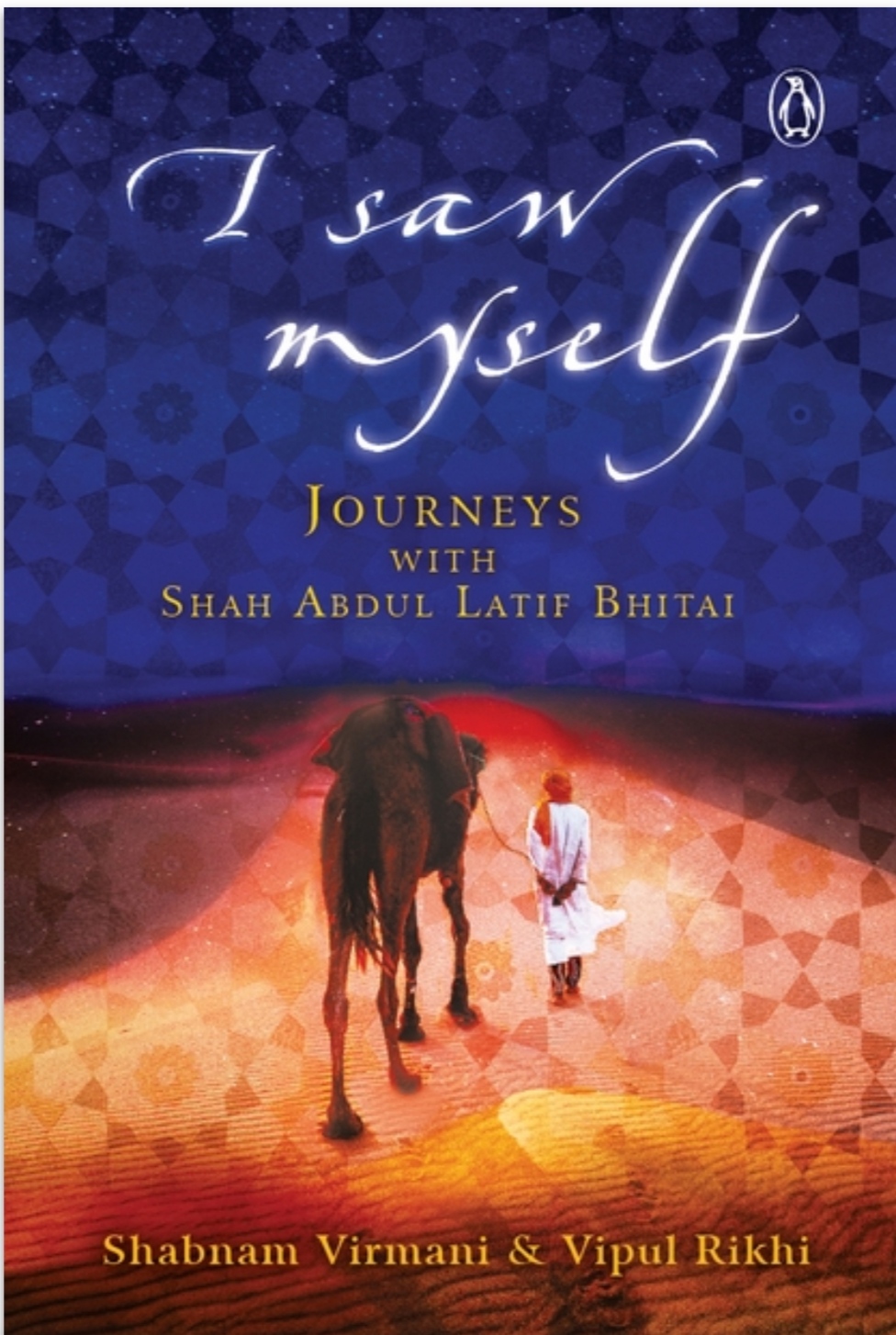
[Travelling into the stark deserts of Kutch, I Saw Myself by Shabnam Virmani and Vipul Rikhi explores the contemporary presence of epic love legends of the region, such as Sohini-Mehar and Sasui-Punhu, brought to throbbing verse by the powerful eighteenth-century Sufi poet Shah Abdul Latif Bhitai. As the authors travel to villages to meet folk singers and lovers of Latif’s poetry, immersing in sessions that stretch into the night, they unearth a unique, thriving love-soaked ethos in which the call to oneness rings out like a defiant manifesto for our divisive times. Retelling epics along with other tales and historical events that created the field of experience from which Shah Latif’s poems sprang, I Saw Myself brings into English a selection of his finest poems. A spell is cast, of story and song, of metaphor and meaning. The insights that emerge are subtle, even startling, radical at times, solace-giving at others, but always deeply meaningful.]
These glimpses of poet Shah Abdul Latif Bhitai’s work shows his greatness cannot be grasped fully. ‘I Saw Myself’ features new translations of the Sindhi Sufi poet’s works by Shabnam Virmani and Vipul Rikhi.
Rita Kothari
Kabir says the well is one
Water bearers many
Their pots are of different shapes
But the water in them in one
— Kabir
I thought the path was one
But there were a thousand million
Whoever took whichever one
Made it across the ocean
— Mekan Dada
One palace, one million doors
Countless windows in between
From wherever I took
The Beloved is before me
— Shah Abdul Latif
The beauty of language, the inwardness of the translation, in the three verses above tell us of the many journeys pursuers-translators have made. It exemplifies not only the continuity of syncretic thought but also a co-habitation of different regions (through Kabir from north India, Mekan Dada from Kutch, Shah Abdul Latif from Sindh) that refuse to stay fixed.
In my mind Shah Abdul Latif collapses with an unforgettable visual I remember from my visit to Jerusalem. After days of witnessing the hostile intimacy with which the Jewish, Christian and Muslim sides in East Jerusalem cohabited, I encountered a view through a glass window that overlooked the structures of all three religions, but was divided and distorted in the window frame. What that brought home was how no narrative is available in the singular; that choosing one over others is possible only through a manipulated vision. Between the villages of Kutch on the Indian side of the border and those in Tharparker across the international boundary resonate with the voice Shah Abdul Latif.
A passion project
As I hold I Saw Myself: Journeys with Shah Abdul Latif Bhittai, it is difficult not to feel somewhat infected by the passion that must have accompanied Shabnam Virmani and Vipul Rikhi when they undertook the project. Each time I say “project” in such a context I am reminded of Farid Ayaz’s words to Virmani recorded in the film Had-Anhad, “Isko zindagi ka project banayein.” And that’s exactly what Kabir and now Shah Abdul Latif Bhittai are – life projects.
And just as we don’t live life alone, this book is also not alone, with a single author or translator, but one that gives a sense of collectivity in its approach and design. Mine and not mine, as Gandhi said of Hind Swaraj. After the enormous value that the Shabnam Virmani-led Kabir project brought to our understanding of the continued relevance of Kabir and his multiple lives in parts of India and Pakistan, enhanced further by the impeccable translations of Linda Hess, we now have with us a new voice and new collection.
This voice is not from the heart of India, but from its frontiers, parts of which are in Pakistan and parts, in Rajasthan and Gujarat. The book is more a journey than a final and comprehensive compendium to the Sindhi Risalo by Shah Abdul Latif. It has verses from the previous compilations, in addition to ones that Virmani and Rikhi hear as a part of the oral tradition in Kutch. In that sense this is an unusual, almost quirky book in that it mimics, despite being textual, the spontaneity of an oral tradition.
A daily presence
The name of Shah Abdul Latif Bhittai is not unknown anymore to those who follow Sufi thought and music even in the most rudimentary manner. Details of Shah Abdul Latif’s life and the arrangement of the Risalo in surs and dastans, and the forms of bayt and wai, are too well known and accessible to bear repetition here. Equally well-known and recorded are the influences of Rumi and of the Quran, of the yogis and of Vedic learning.
These acquire different emphases depending upon ideological positions of the commentators. The stories of Moomal and Rano, of Noori and Jam Tamachi, are dispersed across the western region – Junagadh, Jaiselmer, Barmer, Thar, and Hinglaj. The singing is found in the repertoires of Abida Parveen, Allam Faqir, and Coke Studio.
In Sindh and Banni (Kutch) no conversation of any kind, literally, is possible without someone quoting a bayt from the Risalo. It is so common to hear, “Shah saab chayo aa…” and then a verse that can explain anything from the absence of rain to the betrayal of a lover, from the names of plants to the dilemmas of a spiritual life.
I remember hearing this about an aspiring politician: “andar vihareen kaunv, baaher boli hunj jee,” which means, “with a crow inside you, you speak the language of a swan” and that should give us a gist of the universality of Latif’s themes. But Latif is essentially and firstly a Sufi, who believes in an austere life, a meagre existence and retreat inside. Given below is a famous verse with my rendering in Hindi:
chup kar, chap-a-ma chore,
poore akhyoon dhuka kana
rah udhooru un
ta who moorat
munjharaan man
tunhijo mushahido maneean
chup kar, hoth na hila
aankhe bandh, kaan bandh
paani pee, pet na bhar
kha anaaj bas thoda sa
taaki woh murat ubhar aaye
jo basi tumhare andar
This life of austerity is not without yearning for a beloved, until the lover and the beloved are experienced as one. Words like “pirin” and “supreen” in the Risalo evoke references to friendships and nations of soul mates. Here’s one more verse, again in Hindi.
shukr hai jo mile
jeete dino mein yaar se
baithe jinke pahlu mein
mile hame kitna qaraar
maalik na karna juda
iss pirin ki pados se
Or this,
Sufi ne saaf kiya
thoya panna vajood ka
phir jua iss kaabil
dikhi jhalak yaar ki
A presence across communities
When Sassui looks for Punhoon only to realise that she has become Punhoon herself, or when Marvi longs for her homeland Malir, Sufism ceases to be an inaccessible form – it acquires in the popular imagination stories of love, wisdom, politics that co-exist with the mystical. This combination makes Shah Sahib very unusual and explains his presence across different communities.
Amena Khamisiani, one of the translators of Risalo mentions how “the peasant ploughing his field, the herdsman and the shepherd tending to the herd of cattle or flock of sheep, the fisherman casting his fishing net in the water, the village housewife at her daily chores and the villager amidst his companions at leisure time, sings, recites, or hears this poetry…”
Another translator mentions how his father, a bus conductor, gave him the Risalo, saying in Siraiki, “…aba hi wada kitab tedi wadi madad karesi (my son, this great book will help you greatly).” It is a different and crucial matter that Shah Sahib himself was a Syed and one may argue that his lineage leaves a caste-blind mark on the Risalo.
Recent scholarship by Sufi Hussain draws attention to this phenomenon, and there is no reason why a new assessment of this iconic figure should not take place. My own knowledge of the Risalo is built through memories and versions of people and a textual tradition starting from Ernest Trumpp to HT Sorley, from Elsa Kazi to Kalyan Advani, from Christopher Shackle to Annemarie Schimmel and, now, to Virmani and Rikhi. These are mere glimpses, but we need to be humble and reconcile with the fact that greatness is not graspable fully.
_________________
About the Authors of book
Shabnam Virmani initiated the Kabir Project journeys in 2002 and has since been exploring the philosophy of Kabir and other mystics through a deep engagement with their oral folk traditions. Her inspiration and joy in this poetry and its wisdom has taken the shape of documentary films and a digital archive, songs and performances, translations and curations, urban festivals and rural yatras and more recently, infecting students with the challenge and wonder of mystic poetry. All this as part of her work at the Kabir Project in Srishti, Bangalore. Earlier she has worked on gender issues through journalism, video and radio work in the community.
Vipul Rikhi is a poet, translator and singer, immersed in the oral traditions of Kabir and other Bhakti and Sufi poets for years. He is the author of a novel, 2012 Nights, and a collection of poems, Bleed. He was a literature fellow at the Akademie Schloss Solitude in Germany in 2010-11. In the course of the magical journeys with the Kabir Project, he developed a deep love for singing mystic poetry in the folk music traditions and now performs widely. He is currently based in Goa.
 Rita Kothari is Professor of English at Ashoka University, Delhi. She is one of India’s most distinguished translation scholars and has translated major literary works into English. Rita has worked extensively on borders and communities; Partition and identity especially in the western region of India. She is the author of many books and articles on the Sindhi community.
Courtesy: Scroll