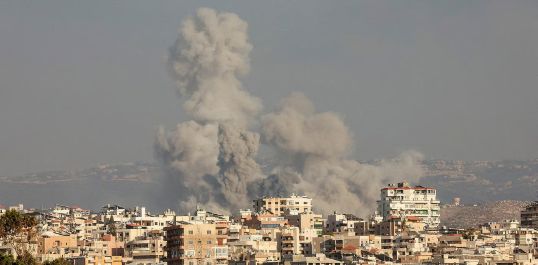
It is a perpetual war for an impossible peace, let alone a peace of mind
Nazarul Islam | USA
A quote that captures the perpetual, often cyclical nature of unrest in the Middle East has remained:
“It is a perpetual war for an impossible peace, let alone a peace of mind.”
This quote highlights the seemingly endless, repetitive nature of the conflict where political, ethnic, and religious divisions are continuously exploited, leading to a state of permanent instability rather than resolution.
Other fascinating quotes drawing reader interest have reflected theme this theme include:
“Middle Eastern wars rarely end with outright victory and permanent stability, so the word ‘settlement’ may promise too much.”
“In the Middle East, the conflict today is a matter of generations and not of cultures.”
As long as we continue to search for enemies anywhere but inside ourselves, there will always be a Middle East problem.”
“Without a concerted effort to end this constant return to violence, it will always be the civilians that suffer first…”
Evidently there existed moments in history when the decline of a great power became more consequential than its rise. Faced with the erosion of long held dominance, such powers acted with a mixture of fear and determination, attempting to hold back the tide of change.
The recent desperate attempts by the Empire to preserve its hegemony: weaponizing global trade, alienating long-standing allies through threats and intimidation, denying the urgency of climate change while promoting fossil fuels, and seeking control over global energy resources through new wars reflect this historical pattern. The unfolding war in the Middle East can therefore be understood, in no small measure, as one of the convulsions of a fading order.
Colonial Legacy and the Birth of a Conflict
At a time when the world was attempting to leave the age of colonialism behind as a relic of the past, one of the most significant colonial enterprises of the twentieth century was being brought into existence. In the aftermath of the Second World War, as Asia and Africa rose in anti-colonial struggles and European empires slowly unraveled, a new political colonial project emerged in Palestine that would fundamentally reshape the Middle East and haunt global politics for decades to come.
For the native Palestinians, the mid-twentieth century did not bring liberation but a tragic reenactment of a familiar colonial pattern. Land was lost, communities were uprooted, and political identity was fragmented as a new state took shape on territory long inhabited by an indigenous population. What unfolded in Palestine bore many of the characteristics of settler colonial brutal and violent histories that had previously transformed societies elsewhere in the world.
Antisemitism was a deeply rooted European problem that reached its most horrifying culmination in the Holocaust. Yet even after the defeat of Nazi Germany, many European societies remained reluctant to absorb large Jewish populations into their own national fabric. Few were willing to facilitate substantial Jewish settlement within Europe itself or in their own settler societies such as the United States, Canada, or Australia, where a huge number of Europeans had migrated themselves.
At a time when their own former colonies were slipping out of their hands, it was rather ingenious on the part of Europeans to punish the Palestinians with the establishment of a new violent settler colony in the form of Israel.
The Rise and Fall of Arab Nationalism
At the same time, a powerful countercurrent was developing across the Arab world. Anti-imperialist national liberation movements were gaining strength, and Pan-Arabism emerged as a potent ideological force.
With its roots laying in the late Ottoman period, Pan-Arabism advanced the idea that Arabic-speaking peoples constituted one nation bound by shared language, history, and culture. Its proponents envisioned the eventual political unification of the Arab world from Morocco to Iraq. Crucially, the movement emphasized secular nationalism rather than religion as the basis of unity and positioned itself firmly against Western political influence in the region.
The ideology reached its zenith in the 1950s and 1960s under Jamal Nasir in Egypt, whose defiance of Western powers during the Suez Crisis of 1956 transformed him into a symbol of anti-colonial resistance throughout the Arab world. Parallel movements gained influence elsewhere.
The Arab Socialist Baath Party, which came to power in Syria and Iraq, promoted a mixture of Arab nationalism and socialism and advocated the political unity of Arab states.
Let the promise of Pan-Arabism gradually unraveled. The decisive turning point came with the Six Day War of 1967, when Israel had inflicted a swift and devastating defeat on Egypt, Syria, and Jordan. The war redrew the territorial map of the region and delivered a profound psychological blow to the ideology of Arab unity. Israel emerged in control of the West Bank, Gaza Strip, East Jerusalem, the Sinai Peninsula, and the Golan Heights.
Read: Earliest deportations of Indians from United States
___________________
 The Bengal-born writer Nazarul Islam is a senior educationist based in USA. He writes for Sindh Courier and the newspapers of Bangladesh, India and America. He is author of a recently published book ‘Chasing Hope’ – a compilation of his articles.