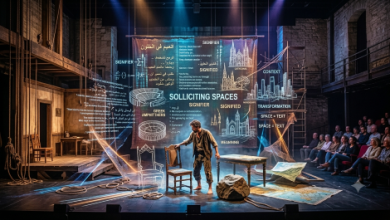
Modern art is a reaction or response of the world to rational practices and new perspectives arising from technological developments after the Industrial Era
Souad Khalil | Libya
Modern art, as defined in Wikipedia, refers to artistic works that emerged approximately from the 1860s to the 1970s. It denotes the styles and philosophies of art produced during that period. The term is usually associated with art in which traditional conventions were abandoned in favor of innovation. Contemporary artists experimented with new ways of seeing, as well as new concepts regarding the nature of materials and the roles of art. Much of modern art tends to move away from narrative (which characterized previous arts) and toward abstraction.
The most avant-garde artistic production is often called contemporary art or postmodern art. When we look at what various scholars write, each offers a different perspective. For example, Dr. Asim Bad al-Amir, an Iraqi writer, discusses the aesthetic and pictorial aspects of modern art:
 If scholars of aesthetic thought consider Aristotelian philosophy as a cornerstone—revolutionizing the very concept of beauty—it is because Aristotle kept beauty within the realm of the physical world, allowing it to be measured and appreciated according to proportion and grandeur, in his view. This represents a significant shift in the structure of aesthetic concepts, the effects of which persist to this day.
Previously, Greek thought, particularly in Plato, had taken a path governed by logic and idealism, reinforced by mystical and poetic sensitivity, aiming to point toward a world beyond our empirical existence. This world, being suspended and lofty, lies beyond the capacity of the senses, which cannot perceive beyond the empirical realm—this realm is relative and limited.
While Aristotelian thought has expanded its influence in literature, poetry, theater, and other intellectual fields, its impact on visual arts has largely been neglected. This underlines the importance of revisiting and appreciating the pioneering ideas of this materialist and objective philosopher. Aristotle facilitated engagement with aesthetic phenomena by situating them within human experience, without relying on the Platonic theory of ideal forms.
 Idealistic thought received wide acceptance in Renaissance visual arts, so much so that Leonardo da Vinci himself worked to embody the principles of idealism, exhibiting a dual tendency between idealism and sensuality. One may closely examine his famous masterpiece, the Mona Lisa—which marked a new era in portrait art—for several reasons:
It shifted beauty from a celestial ideal to an earthly attribute. The work demonstrates early applications of optics and perspective and reveals the ability of sensory perception to convey ideal beauty in a manner consistent with the aims of Renaissance thought, which sought a middle ground between spiritual aspiration and the exploration of hidden beauty in the material world. Although this approach is relative in nature, it represents a pivotal point of innovation compared to the strictly idealistic art of the Middle-Ages.
Turning to Romanticism, often regarded as the last bastion of idealism in art, it functioned as a major counterforce to the rational concepts and solutions that dominated the eighteenth century following Descartes’ proposals. Romanticism restored the cogito to “I feel, therefore I am,” replacing rational logic with intense emotion and passionate drives.
 Romanticism favored ambiguity over reason, individual freedom over the constraints of intellect, emotion over restraint, and the unfamiliar over the familiar. Such pronounced alternatives made this revolutionary movement a critical turning point in European intellectual history since the dawn of the Gothic era, which had largely disregarded affective experience.
Within this context, one can still discern an Aristotelian tendency that cannot be overlooked. Aristotle emphasized that aesthetic models do not necessarily require imitation; elevation or diminution of these models, whether by addition or alteration, suffices.
At the same time, Kantian aesthetics, with its imaginative and emotional horizon, re-examined the nature of aesthetics as merely a matter of judgment rather than logical reasoning. Kant challenged the authority of reason, suggesting that sensory experience allows emotion to play a central role in making necessary aesthetic evaluations.
There is no doubt that Kant’s ideas resonated profoundly with Romanticism, which emphasized free imaginative activity, recalling the conclusions reached by Kant himself.
Imagination, according to Romantic thought, has the ability to generate images without reliance on the senses. Consequently, Romanticism challenged classical concepts that glorified standards such as symmetry, proportion, and balance. Instead, it based itself on the broad principle of imagination, transforming it into a limitless creative field overflowing with images, no longer monopolized by the material world.
It is worth recalling the advice of Delacroix, delivered with a satirical tone in response to the Realist movement: “Close your eyes when you paint.” Here, the leader of Romanticism denies the primacy of the senses, as they are incapable of producing images in the way imagination can.
European modern painting, situated in the interplay between the beautiful and the sublime, or the sensory and the absolute, necessarily revolved around such a duality, which became a central axis for aesthetic thought. This approach influenced Cubism in the first decade and part of the second decade of the twentieth century.
Paul Cézanne, a major pioneer, focused seriously on dismantling the conventional standards that had dominated European painting since the dawn of the Renaissance, specifically from the era of Giotto in the 13th century. He sought to restore the pictorial surface as a text carrying accurate knowledge of weight, mass, and space, an approach that greatly influenced modern painting movements.
 Cézanne’s explorations, particularly in what is known as pure forms, reflect a Platonic reference. Yet, from another perspective, they also bear an Aristotelian foundation in principle: his preparatory studies for Cubism did not treat beauty as tied to the transient, observable material world. Instead, they sought the hidden essence, where truths appear more complete and authentic.
Cézanne’s idealistic rational tendencies are evident: the mental models he pursued in his art recall Aristotle’s conclusions. Creating beauty does not necessarily require strict adherence to reality; often, truths manifest beyond immediate appearances. Cézanne transformed the data of Impressionist painting, expanding its distance and divergence from reality.
This justifies the emergence of Formalism in art, which subsequently grew in abstract painting, emphasizing form with a spiritual intensity.
As Sarah Al-Tamimi notes: Modern art is a reaction or response of the world to rational practices and new perspectives arising from technological developments after the Industrial Era. It enabled society to express itself in ways different from traditional conventions. Artists, in turn, present and represent their experiences of modernity, applying them innovatively in life and artistic practice.
Read: Popular Proverbs in Narrative
_________________
 Souad Khalil, hailing from Libya, is a writer, poet, and translator. She has been writing on culture, literature and other general topics.