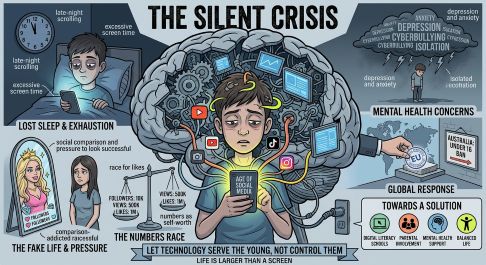
The Silent Crisis: Young Minds in the Age of Social Media
- Excessive screen time, late-night scrolling, social comparison and the growing pressure to appear successful are raising new questions about the mental well-being of our young generation
By Nuzair Ahmed Jamro
When the Phone Becomes the Last Thing We See at Night. There was a time when the end of the day meant a conversation with family, a visit to a friend, reading a book or simply going to bed. Today, however, for many young people, the day does not end when the lights are switched off. It continues on a mobile phone.
One more YouTube video becomes another. One TikTok turns into twenty. An Instagram notification leads to another scroll, and a message leads to another conversation. Before a young person realizes it, midnight has passed and the phone is still in hand.
At first, this may appear to be an ordinary part of modern life. After all, smartphones have become essential tools for education, communication and entertainment. However, when screen use becomes difficult to control, replaces sleep and real-life relationships, and is accompanied by constant comparison with others, it can become a genuine concern for mental well-being.
It is important, nevertheless, to remain balanced. Social media alone does not cause depression, anxiety or other psychological disorders in every user. Mental health is shaped by many factors, including family circumstances, financial problems, academic pressure, bullying, relationships, genetics, loneliness and personal experiences. Even so, increasing research and international health authorities are warning about problematic patterns of digital use among young people.
A Generation Growing Up Online
The scale of young people’s online activity is remarkable. The World Health Organization reported in 2024 that problematic social-media use among adolescents in its European, Central Asian and Canadian survey areas increased from 7% in 2018 to 11% in 2022. The WHO also found that problematic use was associated with difficulties controlling social-media behavior and with negative consequences in everyday life, while such use was linked with less sleep and later bedtimes. These figures should not be interpreted as proof that social media directly causes mental illness. Rather, they indicate that a growing number of young people are developing patterns of use that may interfere with normal life.
This distinction is important because technology itself is not the enemy. A smartphone can be a classroom, a library, a communication tool and a source of useful information. YouTube can help students learn languages, science and professional skills; while social-media platforms can help young people maintain friendships and discover opportunities. The real concern begins when use becomes dependence and entertainment becomes an uncontrollable habit.
The Midnight Screen and the Loss of Sleep
Perhaps one of the simplest explanations for the growing concern is also one of the most overlooked: young people are sleeping less. A teenager who spends hours scrolling before bedtime may not simply be losing those hours of sleep. The constant stream of videos, messages, notifications and recommendations can also keep the mind engaged when it should be preparing for rest. Consequently, a young person may wake up tired, attend school or college without proper concentration, become irritable during the day and then return to the phone at night.
The cycle continues.
The WHO has specifically noted the relationship between problematic social-media use, later bedtimes and reduced sleep among adolescents. Therefore, the question is not only how many hours a young person spends online. We should also ask what those hours are replacing.
If social media replaces sleep, exercise, family conversation, study and face-to-face friendship, the consequences can be much more serious.
From Connection to Isolation
Social media was created to connect people, yet excessive use can sometimes produce the opposite result. A young person may have hundreds of followers and online contacts but still feel lonely. They may spend hours communicating through a screen while avoiding real conversations with family or friends.
Online friendship can certainly be meaningful. However, it cannot always replace the emotional support that comes from sitting with someone, sharing a problem, playing a sport together or having a genuine face-to-face conversation. As a result, families need to look beyond the number of hours a child spends online. They should also ask whether the child is becoming withdrawn from ordinary life.
The Pressure to Look Successful
There is another issue that deserves much greater attention: the race for social status and material success. Social media often presents a carefully selected version of life. We see expensive cars, fashionable clothes, foreign holidays, restaurants, beautiful homes, successful careers and apparently perfect families.
What we usually do not see are the debts, disappointments, family problems, failures and personal struggles behind those images. Nevertheless, a young viewer may compare his or her ordinary life with this carefully edited world.
Gradually, the questions begin: “Why don’t I have what they have?” “Why am I not successful?” “Why does everyone else seem happier?” Such comparisons can affect self-esteem and create unnecessary pressure, particularly among young people who are still developing their identity.
Ambition is healthy. Wanting a better education, career or financial position is perfectly normal. However, when social status becomes the measure of personal worth, ambition can turn into anxiety and dissatisfaction.
The Race for Likes, Views and Followers
For some young people, recognition is increasingly measured through numbers. How many people liked the photograph? How many viewed the video? How many followers were gained this week? These numbers may appear insignificant to an adult, but to a teenager they can sometimes feel deeply personal. A successful post can produce excitement, while an ignored post can produce disappointment. Consequently, some young users repeatedly check their phones for reassurance and approval. This creates a difficult cycle: post, wait, and check, compare, worry and post again.
A young person’s confidence should not depend upon an algorithm deciding whether a photograph or video deserves attention.
Why Depression and Anxiety Can Become More Difficult
Depression and anxiety are complex psychological conditions, and no single explanation can account for them. However, excessive digital engagement can interact with several recognized pressures.
First, sleep deprivation can leave young people physically and emotionally exhausted. Second, social comparison can make ordinary life appear inadequate. Third, cyber bullying and online humiliation can follow a young person even after leaving school. Fourth, social isolation can reduce the availability of genuine emotional support. Fifth, constant notifications and online demands can create a feeling that one must always be available.
Furthermore, social-media platforms are increasingly sophisticated at keeping users engaged. Features such as auto play, infinite scrolling, personalized recommendations and frequent notifications can encourage people to remain online for longer. The European Union has recognized these concerns in its policies for protecting minors online. Its guidelines recommend measures to reduce addictive or excessive-use features and address risks such as cyber bullying and harmful content.
What Are Other Countries Doing?
Pakistan is not alone in confronting this challenge. Interestingly, some of the countries where major technology companies and social-media platforms emerged are themselves debating how to protect young people. In the United States, where companies such as Meta and Google have their headquarters, the U.S. Surgeon General has warned that the evidence is not sufficient to conclude that social media is safe for children and adolescents. The American debate increasingly focuses on the responsibility of technology companies, parents, schools and policymakers.
The European Union, meanwhile, has adopted a stronger regulatory approach. Under its Digital Services Act framework, platforms accessible to minors are expected to protect children’s privacy, safety and well-being. The European Commission’s guidelines address addictive design, harmful content, and cyber bullying and age assurance.
Australia has gone even further. Since 10 December 2025, age-restricted social-media platforms have been required to take reasonable steps to prevent Australians under 16 from holding accounts. The list includes Facebook, Instagram, TikTok and YouTube, among others.
These measures do not mean that Australia has declared social media universally harmful. Rather, the government has decided that younger children require an additional layer of protection while they develop the maturity and resilience to navigate the online world. These international examples are worth studying, although Pakistan should not simply copy another country’s policy. Our cultural, educational, economic and technological circumstances are different.
A Lesson from the Countries behind the Technology
There is an interesting contradiction here. Many of the world’s most influential digital platforms were developed in countries where technology has become deeply integrated into daily life. Yet those same societies are now debating stronger protections for children. This should make us think carefully.
If highly developed technology societies are concerned about excessive screen use, addictive design and children’s online safety, Pakistan should not dismiss the issue as merely a passing fashion among teenagers. At the same time, we should not blame the countries where these companies originated. The issue is not about nationality; it is about responsible technology, corporate responsibility, family behavior and sensible regulation.
Pakistan Needs a Clear Digital-Wellbeing Policy
Pakistan now needs to move beyond occasional warnings about mobile-phone use and develop a comprehensive policy for children’s and adolescents’ digital well-being. The government should consider age-appropriate safeguards for young users, stronger parental-control systems, reliable age-assurance mechanisms where appropriate, and greater transparency from platforms about how recommendation systems affect children.
Furthermore, Pakistan should examine whether features such as infinite scrolling, auto play and excessive notifications should be subject to stronger protections for minors, following international developments in Europe and elsewhere.
At the same time, any regulation should protect children’s access to education, information and legitimate communication. The goal should not be to isolate young people from technology. The goal should be to ensure that technology does not exploit their vulnerability.
Screen-Time Education Should Begin at School
Schools and colleges should also become part of the solution. Digital literacy should no longer mean simply teaching students how to operate a computer. It should also teach them how to manage their digital lives.
Students should learn about healthy screen habits, sleep, online privacy, cyber bullying, misinformation, social comparison and the psychological effects of excessive online engagement. Moreover, schools should provide opportunities for sports, creative activities, reading, debate and face-to-face social interaction.
A balanced young person needs both digital skills and real-world skills.
Parents Must Also Look at Their Own Habits. Parents cannot expect children to follow rules that adults themselves ignore. If parents spend dinner checking WhatsApp messages or scrolling through social media, children naturally receive the message that constant phone use is normal. Therefore, families can establish simple routines: phones away during meals, limited recreational screen use before bedtime, regular outdoor activities and, where possible, keeping phones outside bedrooms during sleeping hours.
More importantly, parents should talk to their children. If a teenager is spending excessive time online, the first question should not always be, “Why are you wasting your life on the phone?”
A better question may be: “Is something happening in your life that makes you want to stay online all the time?”
That conversation could reveal loneliness, bullying, academic pressure, relationship problems or other difficulties that need attention. Mental-Health Services Must Be Strengthened. Technology regulation alone will not solve the problem. Some young people will continue to experience depression, anxiety or other mental-health difficulties for reasons that have nothing to do with social media. Therefore, schools, colleges, universities and public hospitals need accessible psychological support.
The World Health Organization has emphasized that mental-health conditions commonly develop early in life and that countries need to strengthen mental-health services for children and young people. Early help is particularly important. A young person should not have to reach a crisis before finding someone willing to listen. The Government Should Regulate, But Not Overreact. A strong policy does not necessarily mean an absolute ban.
Instead, Pakistan could adopt a balanced framework that combines age protection, screen-time awareness, platform accountability, digital education and mental-health support. The government should also establish an independent system for monitoring the effects of social-media use on children and adolescents. Universities and medical institutions could conduct regular national studies on screen time, sleep, loneliness, cyber bullying, anxiety and depression. In this way, future policy would be based on Pakistani evidence rather than assumptions.
Young People Need a Life Beyond the Screen. Ultimately, this debate is not about taking smartphones away from an entire generation. Young people need technology. They need YouTube for learning, social media for communication and the internet for education and opportunity.
However, they also need something that no application can provide completely: real human connection. They need to sit with their parents. They need friends they can meet in person. They need exercise fresh air, hobbies, books, education and meaningful work.
They need to experience failure without immediately comparing themselves with millions of strangers online. Most importantly, they need to understand that a person’s worth cannot be measured by followers, likes, views, expensive clothes or the appearance of a perfect lifestyle.
Conclusion: Let Technology Serve the Young, Not Control Them
The growing dependence on smartphones and social-media platforms deserves serious attention, but it also deserves a fair and human discussion. We should not blame every psychological problem on Instagram, TikTok or YouTube. Depression and anxiety have many causes, and social media affects different people in different ways. Nevertheless, the growing prevalence of problematic social-media behavior, its association with disrupted sleep and the concerns raised by health authorities and governments around the world provide enough reason to act.
Other countries are already experimenting with different solutions. The United States is debating corporate responsibility and youth mental health; the European Union is regulating platform design and strengthening protections for minors; and Australia has introduced a minimum age of 16 for accounts on major social-media platforms. Pakistan should carefully study these experiences and develop a policy suited to its own society. Above all, however, this is not merely a government problem. It is a family problem, an educational problem, a public-health problem and, ultimately, a social problem.
In nutshell, we need to teach our children that life is larger than a screen. Success is not the number of followers a person has. Happiness is not the number of likes on a photograph. Wealth is not the only measure of achievement, and an attractive online image does not necessarily represent a happy life.
Therefore, the real objective should be to raise a generation that can use technology without becoming dependent on it; communicate online without abandoning real relationships; pursue success without constantly comparing itself with others; and enjoy modern technology without sacrificing sleep, health and peace of mind. Technology should be a tool in our hands not a force that controls how our young people sleep, think, feel and value themselves.
Read: Motorcycle Lights Threaten Sindh’s Roads
____________________
 Hailing from Shikarpur, Sindh, Nuzair Ahmed Jamro is a civil servant and MS research fellow in Public Administration. He writes on governance, public policy, and digital transformation. Email: najamro@gmail.com.