Mules Mansion in Karachi functions as a mirror. When we look at it, we see more than architecture. We see ourselves. We see our priorities. We see our successes and failures. We see what we value. We see what we ignore. The building reflects both Karachi’s greatness and its vulnerabilities.
By: Raphic Burdo
Once upon there was Karachi, a city called ‘city of lights’, ‘a jewel in the British crown of Queen Victoria, on whose empire never set. At the edge of this city’s harbour, where the Arabian Sea exhales its salt-laden breath onto stone and steel, there stood tall, with all its grace and magnificence, the Mules Mansion. The city has withered, has lost its shine and shimmer. Its beaches are more known for fishing than beach games, bars and music. The way Karachi limps on, so does the Mules Mansion. Karachi and Mules Mansion reflect each other’s image and tell each other’s story.
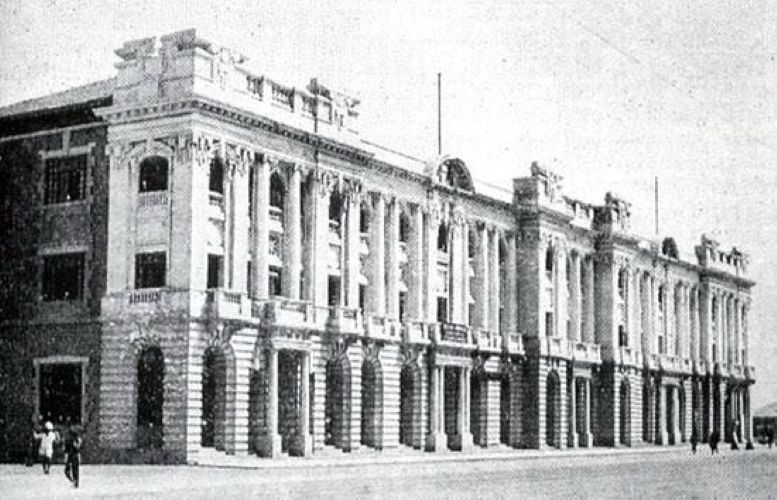 Mules Mansion stands not merely as a building but as a survivor. Its weathered façade rises above a landscape that appears determined to erase the very idea of beauty, elegance and grace. Around it swarm container trucks, oil tankers, handcarts, and motorcycles. All emitting smoke like chimneys. The air vibrates with horns, engines, and the metallic groan of commerce. Nearby lie heaps of garbage left to ferment beneath the tropical sun. Walls are stained by graffiti that unworthy of the walls if a great city. Oil slicks shimmer upon stagnant water. Nearby water bodies and mangroves smell no better than cesspools. Drug addicts, paan chewing loafers, and weed paddlers wander through neglected streets of famed Jackson Market and around. Informal settlements crowd against decaying infrastructure. Dust and soot settle upon every surface human and non-human.
Yet amid this disorder, Mules Mansion retains extraordinary dignity. Like an ageing aristocrat who has outlived both fortune and family, it stands elegantly dressed in the fading garments of another age. Its stone arches still frame the sky with grace. Its balconies still face the sea. Its proportions still reveal a belief that architecture should elevate the human spirit rather than merely shelter human activity.
One cannot look at Mules Mansion without sensing that it has become more than a building. It has become a question: what happened to the city that built this? And perhaps more importantly: what happened to the society that stopped caring for it? These questions are not really about architecture. These are questions about memory, governance, public policy, culture, society and civilization itself. For buildings are never merely buildings. They are frozen expressions of what a society values. They are policy cast into stone. They are philosophy translated into public space. And when they decay, they reveal far more than cracks in masonry. In fact, they reveal cracks in the collective priorities.
Mules Mansion has watched more than a century unfold before its arches and windows. It has witnessed ships arriving from Bombay, Basra, Zanzibar, London, Muscat, and Singapore. It has watched sailors descend gangways carrying stories from distant worlds. It has observed merchants negotiating fortunes, migrants seeking futures, soldiers marching toward wars, and laborers carrying the burden of empire upon their shoulders.
Very few structures in Karachi occupy such a privileged position within the city’s historical imagination. Standing near Karachi Port, it has occupied a front-row seat to one of South Asia’s most fascinating urban transformations. Before Karachi became Pakistan’s largest metropolis, before it became a megacity of more than twenty million people, before it became synonymous with traffic congestion and unplanned expansion, it was a coastal town of modest scale and remarkable openness. The harbour was its heart. The sea was its horizon. Trade was its bloodstream. And Mules Mansion stood near that beating heart.
 Whether you agree or not, buildings possess memories. Not in the manner of human beings, but they remember through endurance. Each layer of paint, each repaired crack, each scar left by weather, or conflict, becomes part of an accumulated narrative. Buildings become archives that cannot be shelved inside libraries. The historian reads documents. The architect reads structures. The citizen reads neither and yet feels both. Mules Mansion is therefore not simply an object of heritage. It is a repository of urban memory.
A city remembers through its streets, parks, monuments, public squares, libraries, theatres, markets, and buildings. When these disappear, memory itself becomes fragmented. The result is not merely physical loss. It is cultural amnesia.
There was a time when Karachi was celebrated as one of Asia’s most cosmopolitan cities. The phrase “City of Lights” was not merely a slogan. It reflected an urban culture distinguished by openness, aspiration, and confidence. The Karachi of the early twentieth century was a city of merchants, sailors, financiers, civil servants, industrialists, dockworkers, teachers, artists, and migrants. Its population included Sindhis, Balochs, Parsis, Hindus, Muslims, and Christians, Jews, Goans, Armenians, Gujaratis, Memons, and many others. Languages overlapped. Cultures intersected. Ideas travelled.
The port connected Karachi not only to trade routes but also to intellectual and cultural currents. This cosmopolitanism was not accidental. Ports have always produced openness. Cities connected to oceans learn early that diversity is not a threat but a necessity. Trade requires trust. Trust requires coexistence. Coexistence generates culture. And culture produces confidence. Mules Mansion emerged from that confidence.
The builders of Mules Mansion were not constructing a structure merely to fulfil a functional requirement. They were participating in the creation of a city. This distinction matters.
Modern development often concerns itself with outputs: roads built, housing units delivered, kilometers paved, square feet constructed. Civilizations concern themselves with meaning. A city becomes memorable not because of the quantity of concrete it consumes but because of the quality of life it creates. Paris, Istanbul, Rome, Kyoto, Prague, Isfahan, and Samarkand are not admired because they built the most structures. They are admired because they built identities. Identity is the invisible infrastructure of civilization. And heritage buildings are among its most visible manifestations.
One of the great tragedies of the modern world is that development is increasingly measured through indicators that are easier to count than to understand. Governments celebrate GDP growth. Administrations report kilometers of roads. Planning agencies publish statistics about housing, transport, and investment. Of course, all of these matter but they do not tell the whole story.
A society may become wealthier while becoming culturally poorer. A city may become larger while becoming less livable. An economy may expand while public beauty contracts. Development, when reduced to economics alone, becomes incomplete. Renowned English intellectual and writer of “Culture and Anarchy”, Matthew Arnold warned against precisely this tendency in the nineteenth century. He observed the enormous material achievements of industrial society while simultaneously recognizing the dangers of spiritual and cultural impoverishment. For Arnold, culture represented a counterbalance to narrow self-interest. It represented humanity’s pursuit of excellence, harmony, and collective refinement. His concerns remain surprisingly relevant.
What happens when societies become preoccupied with economic growth but neglect cultural inheritance? What happens when budgets allocate billions for infrastructure but little for restoration? What happens when heritage is viewed as a luxury rather than a public asset? The answer can be seen in many postcolonial cities. Historic districts have been allowed to crumble. Public spaces led to deterioration. Architectural treasures designed to vanish. And yet development reports continue to celebrate progress. Mules Mansion challenges this logic. It asks whether a city can truly be called developed while allowing its historical memory to decay.
Heritage preservation is often misunderstood. Many policymakers treat it as a niche concern. Or consider it as an issue for historians. An interest of architects. A hobby for cultural enthusiasts. This view is profoundly mistaken. Heritage preservation is fundamentally a public policy issue. It intersects with tourism, education, urban planning, economic development, civic identity, environmental sustainability, and social cohesion. Cities that preserve heritage generate economic value. Visitors travel to experience authenticity. Creative industries flourish around cultural assets. Property values often increase. Public spaces become more attractive. Investment follows quality. Yet the strongest argument for preservation remains neither economic nor aesthetic. It is, for all practical purposes, civic.
Heritage provides continuity. It allows citizens to understand themselves as participants in a longer story. Without continuity, societies become vulnerable to fragmentation. People cease to feel connected to place. Neighborhoods lose meaning. Public life weakens. Citizens become consumers of urban space rather than custodians of it. The preservation of Mules Mansion is therefore not simply about saving a building. It is about preserving a relationship between Karachi and itself.
Every city is ultimately a physical expression of governance. Roads reveal priorities. Parks reveal priorities. Libraries reveal priorities. Schools reveal priorities. And neglected buildings reveal priorities as well. Urban landscapes are policy documents written in concrete, steel, stone, and asphalt. When one examines the surroundings of Mules Mansion today, uncomfortable questions emerge: how does a structure of such significance come to exist amid such neglect? Why do areas of immense economic importance often suffer from environmental degradation? Why are heritage districts frequently treated as afterthoughts? Why does restoration remain episodic rather than systematic? The answers lie not in a single institution but within broader systems of governance.
Fragmented authority. Weak enforcement. Inadequate maintenance. Short political time horizons. Insufficient coordination. Competing priorities. All contribute to urban decline. Yet governance failure should not be interpreted solely as administrative incompetence. Often it reflects something deeper. A failure of imagination. Great cities are built not merely through engineering but through vision. Vision requires asking what kind of city future generations should inherit. Management concerns today’s problems. Statesmanship concerns tomorrow’s inheritance. The difference is enormous.
Human beings are uniquely aware of mortality. We know we will die. Perhaps this awareness explains our desire to build. Buildings become extensions of memory. They allow individuals and societies to leave traces behind. A monument says: we were here. A library says: we learned here. A university says: we thought here. A heritage building says: we lived here. The destruction of such places therefore carries emotional weight beyond their material value. Something intangible disappears. A thread connecting generations is severed. Mules Mansion embodies this tension between permanence and impermanence. For more than a century it has resisted weather, politics, economic upheaval, demographic transformation, and urban chaos. Yet even stone has limits. No building lives forever.
The question is not whether buildings die. The question is how they die. Some perish through natural ageing. Others through disaster. Still others through neglect. Neglect is perhaps the saddest form of death because it is preventable. It reflects not inevitability but indifference. And indifference is a moral choice.
Modern governments devote considerable attention to the future. Economic growth. Technological advancement. Infrastructure expansion. Digital transformation. These are necessary pursuits. But governments also possess obligations to the past. Not because the past is sacred. Not because history should be frozen. But because continuity matters.
Nations are conversations across generations. The dead contribute to those conversations through institutions, traditions, ideas, and physical structures. The living inherit them. Future generations will inherit whatever remains. Public policy therefore operates simultaneously across three dimensions of time. It must serve present needs. It must prepare for future challenges. And it must steward inherited assets.
A government that ignores the future is irresponsible. A government that ignores the past is equally shortsighted. Heritage preservation is not nostalgia. It is stewardship. The distinction matters enormously. Nostalgia seeks to return. Stewardship seeks to carry forward. One looks backward. The other creates continuity. Mules Mansion deserves preservation not because Karachi should return to 1917 but because the city of Karachi deserves access to its own memory.
Cities, in their own right, possess personalities. Some are disciplined. Some are energetic. Some are contemplative. Some are restless. Karachi has always been restless. Its energy comes from movement. People arrive. People depart. Money flows. Ideas circulate. The city constantly reinvents itself. This dynamism is among its greatest strengths. Yet dynamism without memory becomes instability.
A city requires anchors. Heritage buildings perform this function. They provide continuity amid change. They remind citizens that they belong to something older and larger than themselves. Remove enough of these anchors and a city risks becoming interchangeable with any other urban agglomeration. A collection of roads, buildings, and transactions. Functional perhaps. Profitable perhaps. But forgettable.
The world’s greatest cities are memorable precisely because they preserve layers. Ancient and modern coexist. History and innovation interact. Memory and aspiration reinforce each other. This balance remains one of the central challenges of urban policy in the twenty-first century.
 Ultimately, Mules Mansion in Karachi functions as a mirror. When we look at it, we see more than architecture. We see ourselves. We see our priorities. We see our successes and failures. We see what we value. We see what we ignore. The building reflects both Karachi’s greatness and its vulnerabilities. It reflects the ambition that once created extraordinary public spaces. It reflects the governance failures that allowed deterioration. It reflects the resilience of heritage. It reflects the fragility of memory. And it reflects the choices still before us. For the story of Mules Mansion standing on the harbour of Karachi is not finished. Its future remains unwritten. Restoration remains possible. Revitalization remains possible. Renewed civic pride remains possible. The building has not yet surrendered. The question is whether the city has also no surrendered.
As evening descends upon Karachi Harbour, the stone walls of Mules Mansion absorb the last light of the setting sun. Ships move across distant waters. Cranes continue their labor. Traffic roars. The city rushes onward, impatient as ever. And there, amid noise and neglect, stands the old mansion. Watching. Remembering. Waiting. Waiting for a city to decide whether memory matters. Waiting for policymakers to decide whether heritage belongs within the vocabulary of development. Waiting for administrators to recognize that cultural assets are not ornamental luxuries but strategic resources. Waiting for citizens to understand that every lost building diminishes not only a skyline but a civilization.
In my view, the ultimate lesson of Mules Mansion in Karachi is that urban decline rarely begins with buildings. It begins with ideas. It begins with the gradual abandonment of stewardship. It kick starts with the belief that development can be measured solely in economic terms. The decline, more often than not, begins with the assumption that culture is secondary, heritage expendable, beauty optional, and memory negotiable. The fate of Mules Mansion therefore raises a final and unsettling question: is this merely the story of an old building overlooking Karachi Harbour? Or is it a story about governance that forgets inheritance, planning that neglects meaning, development that confuses growth with progress, administrations that prioritize transactions over civilization, and societies that slowly lose sight of the difference between building cities and merely expanding them?
If Mules Mansion ultimately falls, the greatest loss will not be measured in stone, timber, or architecture. The greatest loss will be the realization that what disappeared was not merely a building. What disappeared was a fragment of memory, a piece of civic identity, an expression of cultural confidence, and a reminder that cities, like nations, are judged not only by what they create, but also by what they choose to preserve.
Read: Life After Che – Short Story
_____________________
Raphic Burdo is a student of Literature, Psychology, Public Policy and Entrepreneurship. He writes on the subjects where all four intersect.