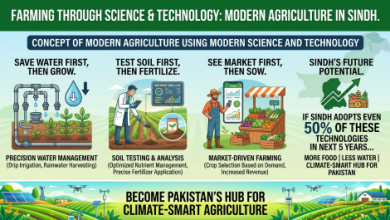
Agriculture is the backbone of our economy, and modernizing it is not just an option but the most critical need of our time.
By Abdullah Usman Morai | Sweden
The history of the world shows that every civilization that was strong in agriculture also remained robust economically, socially, and politically. Food remains the fundamental need of human beings today, and will likely remain so even thousands of years from now. Artificial Intelligence (AI), modern industries, and technological advancements are certainly important, but if grains, vegetables, fruits, and food are not produced on earth, all claims of progress will become meaningless. Therefore, agriculture is not merely the name of an economic sector, but the very foundation of a nation’s survival, sovereignty, and stability.
Pakistan, especially Sindh, is an agricultural region where the livelihoods of millions of people depend on farming. Unfortunately, we still largely depend on traditional methods. At the same time, climate change, water scarcity, rising temperatures, unpredictable rains, floods, and droughts have become major threats to our agricultural system. If we do not step toward modern agricultural technology today, ensuring food supply for future generations could become a massive challenge.
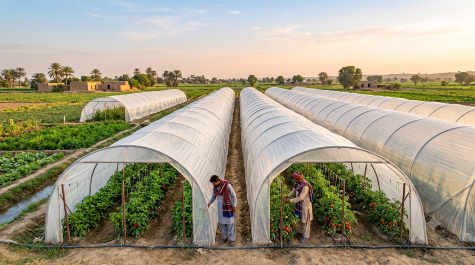
In such a scenario, tunnel farming is emerging as a revolutionary concept for the agriculture of the future. Tunnel farming is a modern agricultural system where crops are grown under plastic sheets or specialized protective structures, where temperature, humidity, moisture, light, and airflow can be controlled to a certain extent. As a result, plants remain safe from extreme heat, cold, fierce winds, hailstorms, and unseasonal rains, allowing them to grow in a much healthier manner.
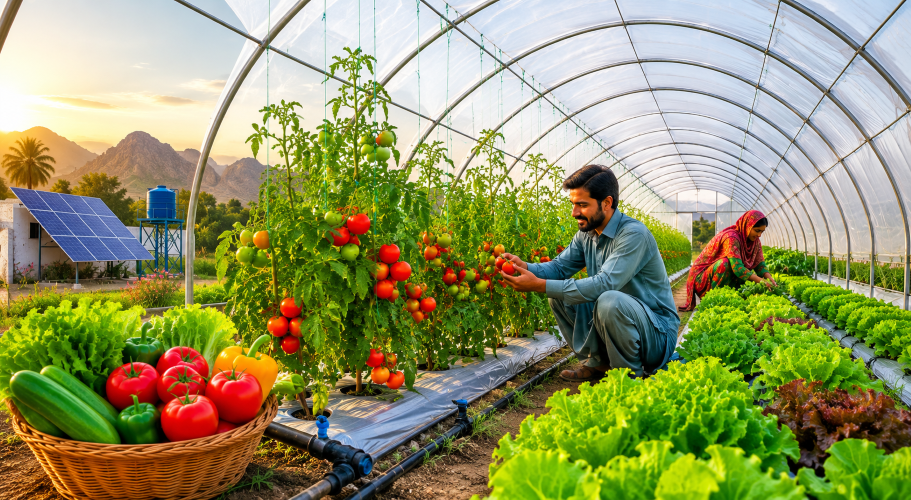 For a province like Sindh, where water scarcity is worsening every year, tunnel farming can prove to be a blessing. In traditional agriculture, a large amount of water is wasted, whereas using modern systems like drip irrigation alongside tunnel farming delivers water directly to the roots of the plants, making immense water savings possible. In the future, water may become a resource more valuable than oil; therefore, saving every drop of water is a national responsibility.
Today, the global population is growing rapidly. Pakistan’s population is also constantly increasing, which will simultaneously drive up the demand for food. If production does not increase at the same pace, a massive gap will open between demand and supply, leading to food shortages, inflation, and poverty. Tunnel farming can yield higher production even on limited land, which can not only fulfill domestic needs but also significantly boost agricultural exports.
A major advantage of tunnel farming is that crops can be grown throughout the year. Under normal conditions, vegetables or fruits restricted to specific seasons can be produced ahead of time or off-season inside the tunnels. When there is a shortage of a commodity in the market, its price skyrockets, thereby yielding higher profits for the farmer. This can make the agricultural sector more commercial and profitable.
Many people believe that tunnel farming is limited only to tomatoes or cucumbers, but the reality is far broader. Along with tomatoes, chillies, ladyfinger (okra), spinach, lettuce, cauliflower, cabbage, eggplant, cucumbers, carrots, radish, coriander, mint, and many other vegetables, crops/ fruits like strawberries, melons, watermelons, floral crops, aromatic herbs, medicinal plants, and high-quality seeds can also be successfully cultivated. In many countries, high-value crops are grown through tunnel farming and exported to global markets.
If research and modern agricultural science are further promoted, in the future, cotton nurseries, vegetable seeds, raw materials for medicines, and many other cash crops, even wheat and sugarcane to a limited extent, or during specific stages, can be produced more successfully through tunnel farming. This will increase agricultural income and reduce environmental risks.
Another great benefit of tunnel farming is environmental protection. Because crops are grown in a protected environment, many harmful pests and diseases are minimized, which reduces the use of pesticides. Fertilizers, especially urea, can also be used in limited quantities based on exact requirements, which maintains soil fertility and reduces environmental pollution. The trend of the future world is shifting toward organic and safe food, and tunnel farming can play a vital role in achieving this goal.
This concept should not be restricted to large landowners alone. Small farmers, rural families, schools, colleges, universities, and urban residents can also set up small tunnels to produce fresh vegetables and fruits for their personal needs. If every household starts producing some vegetables for their own consumption, it will not only reduce household expenses but also enhance food security, while fostering a love for nature and agriculture in children.
Unfortunately, in Pakistan, agriculture is still viewed as a traditional livelihood rather than a modern industry. However, the reality is that in the coming era, smart agriculture, artificial intelligence, sensor technology, solar energy, water-saving systems, and controlled-environment agriculture will form the core of global food production. If we do not adopt these technologies in time, we will lag behind in global competition.
It is the responsibility of the government to make tunnel farming a vital part of the national agricultural policy. Farmers should be provided with easy loans, subsidies, solar systems, drip irrigation, quality seeds, technical training, and direct access to markets. Agricultural universities and research institutes must be linked with ground realities to deliver new research directly to farmers. Model tunnel farms should be established in every district to provide practical training to youth, transforming agriculture into a modern and profitable profession.
We must also understand that future wars may not be fought over land or oil, but over water and food. The country that possesses the capacity to produce its own food will remain strong and sovereign. Therefore, investing in research, innovation, efficient water usage, the development of new seed varieties, modern machinery, and methods like tunnel farming is equivalent to investing in national security.
Sindh possesses fertile land, hardworking farmers, and a vast treasure of agricultural traditions. The only need is for us to embrace modern science alongside old practices. We must save every drop of water, extract more and better yield from every inch of land, and make agriculture more sustainable for future generations.
If we seriously work on tunnel farming, modern irrigation systems, agricultural research, and climate-adaptive policies today, we will not only fulfill the food requirements of our growing population but also secure a strong position in global agricultural markets. Agriculture is the backbone of our economy, and modernizing it is not just an option but the most critical need of our time.
Read: Bonds of Faith and Tradition
_____________________________
 Abdullah Soomro, penname Abdullah Usman Morai, hailing from Moro town of Sindh, province of Pakistan, is based in Stockholm Sweden. Currently he is working as Groundwater Engineer in Stockholm Sweden. He did BE (Agriculture) from Sindh Agriculture University Tando Jam and MSc water systems technology from KTH Stockholm Sweden as well as MSc Management from Stockholm University. Beside this he also did masters in journalism and economics from Shah Abdul Latif University Khairpur Mirs, Sindh. He is author of a travelogue book named ‘Musafatoon’. His second book is in process. He writes articles from time to time. A frequent traveler, he also does podcast on YouTube with channel name: VASJE Podcast.