When mythology becomes inherited truth, history may disappear behind the veil of perception.
By Kalavanti Raja
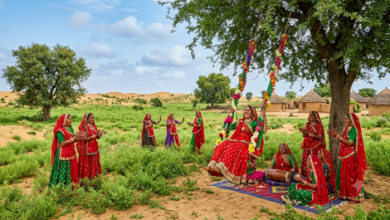
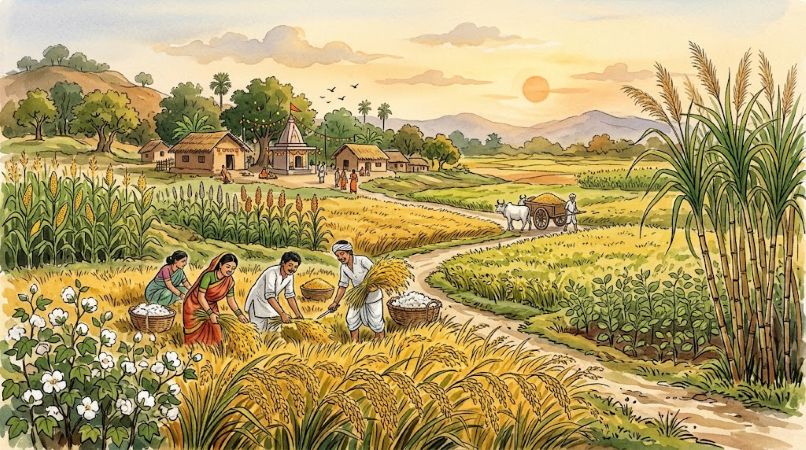
Dasahra has celebrated two days ago and Diwali is to be celebrated within a week. The season is Hemant, that gentle threshold between autumn and winter when the scorching breath of summer has long subsided, the monsoon clouds have withdrawn beyond the horizon, and the earth begins to dress herself in the quiet splendour of approaching winter. Across the ancient plains of the Indian subcontinent, the fields are alive with the rewards of human labour. Rice bends beneath the weight of its golden grain, cotton unfolds its white blossoms, sugarcane rises proudly towards the fading sun, while maize, bajra, jowar and moong announce the abundance of the Kharif harvest. The winds grow tender, the evenings turn cool, and the soil, having received the sweat of its cultivators, prepares to return their devotion in the form of food, prosperity and hope.
It is the season when nature herself appears to celebrate. Yet, beneath the shimmering glow of countless Diwali lamps, a question waits patiently in the shadows of history. Were these lights first kindled to welcome a returning prince, or had they already illuminated the humble homes, fertile fields and ancient settlements of the subcontinent long before the story of his homecoming became inseparable from the festival?
And behind the flames that consume Ravana’s towering effigy every Dussehra stands another question, perhaps even more unsettling. Was Ravana merely the monstrous embodiment of evil that generations have been taught to despise, or does the familiar narrative conceal other memories of a powerful, learned and accomplished ruler whose defeat carried a different meaning for different peoples?
These questions lead us towards one of philosophy’s most fascinating concerns: the distance between reality and the reality we believe we know.
Human beings do not enter this world carrying religious scriptures, cultural prejudices, ancestral loyalties or established judgments about heroes and villains. A child is born into a family, a religion, a language, a caste, a region and a society. Long before that child develops the intellectual freedom to question, the surrounding world has already begun to provide answers. Certain figures become sacred, others become wicked; certain victories become occasions for rejoicing, while certain defeats are condemned to eternal disgrace.
Thus, perception is quietly shaped before independent understanding has even begun. This is where the philosophical problem commonly called the Veil of Perception, associated with the thought of John Locke (1632–1704), becomes relevant. Locke, in An Essay Concerning Human Understanding (1690), explored how knowledge arises through experience and how the mind encounters the world through ideas and perception. His inquiry belongs to a wider philosophical tradition that includes Plato (c. 428/427–348/347 BCE), whose Allegory of the Cave distinguishes shadows from deeper understanding; David Hume (1711–1776), who questioned the certainty of human inference; and Immanuel Kant (1724–1804), who examined the limits imposed by the structures of human experience.
 Their philosophies differ considerably, yet together they invite a question of enduring importance: how much of what we confidently call reality is the world as it exists, and how much is the world as our minds have learned to interpret it?
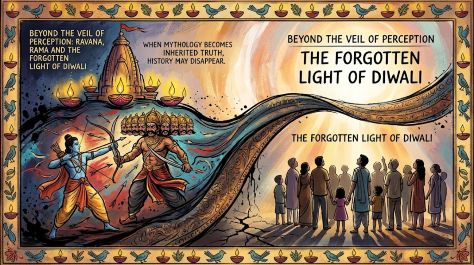
The story of Rama and Ravana offers a remarkable setting in which to explore this question. In the familiar telling of the Ramayana, Ravana, the mighty king of Lanka, has fallen in battle. His own brother Vibhishana has joined Rama’s side, and Rama, accompanied by Lakshmana and Sita, prepares to return to Ayodhya after fourteen years of exile. The defeat of Ravana becomes the triumph of righteousness, while the homecoming of Rama becomes, in a widely cherished tradition, the occasion for illuminating the city with countless lamps.
The narrative has travelled through centuries, entered temples and households, inspired poetry and theatre, and become deeply woven into the cultural and religious life of millions.
But literature, however sacred or influential, is not identical to independently verified history. Who was Ravana beyond the image preserved in popular celebration? Who determined that his defeat must forever represent the victory of goodness? And why do some communities remember him with reverence rather than contempt?
Even within the Sanskrit epic tradition, Ravana is no ordinary villain. He is portrayed as a formidable sovereign, a man of immense learning, a devotee of Shiva, a possessor of extraordinary powers and a figure whose intellectual and political stature cannot simply be dismissed. His ten heads, frequently represented in religious art and popular imagination, have also been interpreted symbolically as expressions of exceptional knowledge, although traditions differ in explaining their meaning.
A figure endowed with such complexity cannot easily be reduced to a painted effigy destined for the flames. In several Dravidian, Dalit and indigenous interpretations, Ravana emerges not merely as an antagonist but as a symbol of learning, dignity, resistance and cultural identity. Some regard him as representing an ancient indigenous ruler whose memory was transformed through later religious narratives. These interpretations deserve serious examination, even though archaeology has not established that Ravana was an identifiable historical Dravidian or Adiwasi king, nor that the Ramayana records a demonstrable war between two ancient ethnic populations.
The distinction is essential. Cultural memory is historically significant, but it is not automatically proof of the literal events it remembers. For communities that identify Ravana with their own heritage, Dussehra may not evoke the unqualified happiness felt by those who celebrate Rama’s victory. The burning of his effigy can instead become a symbol of humiliation or loss. What one tradition celebrates as the destruction of evil, another may question as the condemnation of a figure it has come to respect.
And perhaps the greatest testimony to the richness of the Ramayana is that it has never belonged to a single voice. Across India, Sri Lanka and Southeast Asia, its characters, moral judgments and narrative emphases have changed with language, religion, geography and social experience. Rama remains central to many devotional traditions, yet Ravana too has acquired meanings that cannot be contained within one familiar interpretation.
Then comes Diwali, with its lamps, its prayers, its festivities and its promise of renewal. Long before electric lights transformed the night into day, agricultural societies lived according to the great calendar of nature. Their existence depended upon the arrival of rain, the sowing of seeds, the endurance of crops and the generosity of the harvest. The passing of the monsoon and the approach of the cooler season were not merely changes in weather. They marked a decisive moment in the struggle for survival.
Across different regions, the Kharif agricultural cycle brought rice, cotton, maize, bajra, jowar, moong and sugarcane, although their harvest times varied according to crop and locality. For the cultivator, these were more than agricultural commodities. They represented the security of children, the nourishment of families, the settlement of obligations and the hope of another year.
What could be more natural than to welcome such abundance with lamps, music, shared meals, prayers and gratitude? The historical development of Diwali reveals precisely such a rich and layered cultural landscape. The festival has associations with seasonal change, agricultural prosperity, the lighting of lamps, the worship of Lakshmi, the remembrance of King Bali and several other religious traditions. Its significance extends well beyond any single narrative.
This raises a compelling historical possibility: the celebration of lamps and seasonal abundance may have developed through older and overlapping customs before the story of Rama’s homecoming became one of Diwali’s most familiar explanations.
Indeed, the widely repeated identification of Rama’s return with Deepavali is not explicitly established in the principal Valmiki Ramayana narrative. Other literary and religious traditions preserve different associations with the festival. This does not invalidate the devotional significance of Rama’s homecoming, but it does challenge the assumption that the entire history of Diwali can be traced to that event alone.
Nor can we confidently establish that Rama deliberately selected an already existing harvest festival for his return, or that Lakshmi Puja historically preceded the events described in the epic. Such claims require chronological evidence that the surviving sources do not provide.
Yet the broader historical picture remains fascinating. Lakshmi, the goddess of prosperity, became central to important Diwali observances. Farmers could celebrate the abundance of their fields, merchants could welcome a new financial year, families could seek happiness and good fortune, and devotees could honor the divine according to their own traditions. In different communities, the same festival acquired different meanings, each adding another layer to its cultural inheritance.
The lamps, therefore, illuminate a history far wider than the gates of Ayodhya. The written record offers valuable guidance in examining these questions. P. K. Gode (1891–1961), in his historical studies of Diwali, explored the festival’s seasonal, agricultural and religious associations. Paula Richman’s Many Ramayanas: The Diversity of a Narrative Tradition in South Asia (1991) brought together scholarly examinations of the epic’s remarkable diversity. Periyar E. V. Ramasamy (1879–1973), in The Ramayana: A True Reading, challenged conventional portrayals of Rama and Ravana from a Dravidian social-reform perspective. Osho (1931–1990), in his philosophical discourses, questioned inherited religious judgments and drew attention to Ravana’s extraordinary intellectual stature.
These writings do not collectively establish one alternative version as the final historical truth. Rather, they reveal the necessity of examining inherited narratives through literature, comparative traditions, reason and evidence.
Nor has this spirit of intellectual questioning been absent from Sindh. The land of the Indus, nourished by one of humanity’s oldest urban civilizations, has produced its own powerful tradition of progressive thought, rational inquiry, literary resistance and social criticism. G. M. Syed (1904–1995), Rasool Bux Palijo (1930–2018), Muhammad Ibrahim Joyo (1915–2017), Sobho Gianchandani (1920–2014) and Shaikh Ayaz (1923–1997), each through his distinctive intellectual and political journey, contributed to debates about identity, social justice, inherited authority, human dignity and the freedom of thought.
Their contributions differed in emphasis and philosophy, and it would be inaccurate to assume that they all shared a particular interpretation of Ravana or Diwali. Yet their broader intellectual legacy belongs to a tradition that refuses to treat every inherited social arrangement as beyond examination.
Joyo’s commitment to education and intellectual awakening, G. M. Syed’s reinterpretations of Sindh’s historical and cultural identity, Sobho Gianchandani’s progressive and humanist outlook, Shaikh Ayaz’s poetic rebellion against injustice, and Rasool Bux Palijo’s writings and political engagement with class, culture, history and social emancipation all illuminate different paths towards critical consciousness.
Their work reminds us that the history of a civilization cannot be understood solely through the voices of kings, priests, conquerors and ruling classes. The experiences of peasants, workers, women, indigenous communities and those excluded from positions of authority must also be heard.
For the past is not merely a procession of celebrated rulers and defeated enemies. It is the accumulated memory of countless human beings whose labor built cities, cultivated fields, preserved languages and carried civilization from one generation to the next.
This brings us once more to the Veil of Perception. A child born into one religious tradition may grow up regarding Rama as the embodiment of righteousness and Ravana as the symbol of evil. Another child, raised within a different cultural memory, may encounter a more sympathetic image of Ravana. Both children may inherit their earliest convictions with equal sincerity, long before either has studied the texts, examined historical evidence or encountered alternative interpretations.
With repetition, belief becomes familiarity. Familiarity becomes certainty. Certainty becomes identity. And identity, when defended without reflection, may eventually become a barrier to understanding.
But truth does not become truth merely through repetition, nor does an inherited tradition become false simply because it is old. To question is not necessarily to reject. To investigate is not necessarily to insult. To examine a sacred narrative historically is not to deny the spiritual meaning it holds for those who cherish it.
The real challenge is to distinguish the different realms of mythology, faith, cultural memory, literary imagination and demonstrable historical fact.
The purpose of lifting the veil is not to replace devotion to Rama with unquestioning devotion to Ravana. That would merely exchange one inherited certainty for another. The purpose is to cultivate the courage to ask whether our judgments arise from independent understanding or from the invisible influence of the worlds into which we were born.
Perhaps beneath the celebrated religious narratives of the subcontinent lie older memories of agricultural communities, seasonal festivals, political struggles, cultural encounters and the enduring human desire for prosperity. Some of these memories may survive in ancient texts and regional folklore. Others may have been transformed by centuries of religious imagination. Still others may remain forever beyond the reach of historical certainty.
Yet uncertainty is not a reason to abandon inquiry. It is a reason to pursue it with greater care. And now, as Hemant approaches, the earth continues her ancient work. The rice ripens without asking the farmer’s religion. Cotton opens its blossoms without knowing caste. Sugarcane sweetens beneath the same sun that shines upon temple, mosque, monastery and village hut. The monsoon does not distinguish between the descendants of kings and the children of laborers, and the changing seasons recognize no boundaries drawn by human prejudice.
The lamps of Diwali may illuminate magnificent temples and royal palaces, but they also shine in the modest homes of those whose hands cultivate the soil. Perhaps, then, the most meaningful celebration of light is not confined to the burning of an effigy, the repetition of an inherited victory or even the illumination of a thousand homes.
Perhaps its deepest meaning lies in the illumination of the human mind. Let the lamps shine for the harvest and the hands that gathered it. Let them shine for the dignity of indigenous peoples, for the diversity of ancient civilizations, for the wisdom preserved in competing traditions and for the freedom to question what generations have taught us to accept without examination.
Let them illuminate the distance between faith and history, between memory and evidence, between the world we have inherited and the world we are still struggling to understand. For the deepest darkness is not always the absence of light.
Sometimes it is the presence of a belief so deeply rooted that we have forgotten how to question it. And perhaps the greatest Diwali of all begins not when another lamp is lit upon the doorstep, but when a human being gathers the courage to lift the Veil of Perception and look, with an open mind, beyond the story they were taught.
Read: Reading Karachi’s Darkest Chapters
__________________
 Kalavanti Raja is a social and political activist from Gambat, Khairpur Mirs, with 30 years of work on women’s rights, minorities, and social justice. She has served in Sindhiyani Tahreek and participated in national and international forums across Asia, Europe, and America.. She can be reached at kalavanti.raja@gmail.com