Stories of Karachi’s Taxi Drivers from 1993 to 2000
Zaffar Junejo
[Author’s Note: I joined a non-government organization in mid-1993. In those days, we were frequent travelers to other Asian countries, and during that period I maintained a diary. I once showed the notes to Muhammad Ibrahim Joyo — the legendary scholar, translator, and intellectual giant of the Sindhi world — who suggested categorizing the entries by theme and getting them published. He recalled that long ago, perhaps in 1955, the Sindhi journal Mehran had launched a similar idea titled ‘Hik Deenh Ji Ghaleh’ (The Story of a Day), even offering a prize for it. He himself had submitted the first story, he told me with a smile, just to set a standard for other writers. Later, Maulana Ghulam Muhammad Girami, a scholar of high standing and journalist; Shamsher ul Haidri, a distinguished Sindhi poet, journalist, and playwright; and Siraj ul Haq Memon, an iconic novelist, linguist, and journalist, all contributed their observations of a single day. These writings were published until 1968.
I agreed with Joyo Sahib that I would group the write-ups by subject and get them published, but I failed to do so. Recently, I sat down to organize my notes. I found various entries about the taxi drivers of Karachi city. Some were very brief and incomplete; others were short but held a finished truth. I have chosen five stories from each year, all of them gathered from the drivers of those cars. In total, there will be thirty-five stories covering the period from 1993 to 2000.]
Honest, All of Them
I have heard this story of gold and wealth many times. Out of every five drivers at the station, one tells this exact tale, each with different shades and details. But one point remains common in all their words: the driver was an honest man.
This is how Farhan tells it.
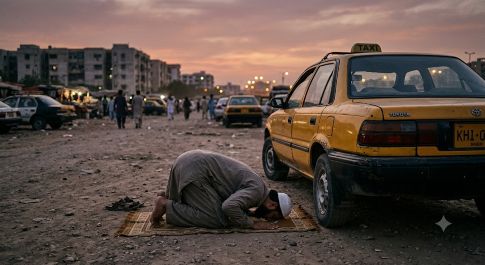
Farhan rubbed the grime off the steering wheel. The rag was gray and greasy. He reached across the vinyl seat to clean the left side, and his fingers struck hard leather. A pouch lay in the dark footwell. It had the heavy, cold pull of metal. He pulled the brass zipper back. Under the yellow dash bulb, the links gleamed. A heavy bridal set. Pure gold.
His chest tightened. Amanat. A sacred trust.
He dropped the pouch into the dashboard slot box, shut the plastic flap, and went home to sleep.
At dawn, the light hit the glass like a flat palm. The market grew loud around the stationary cab.
A man in a sharp linen kameez rapped on the window. “Sindh Assembly…”
Farhan looked straight ahead. He did not pop the lock.
An old woman with a cane pointed north toward Aga Khan Hospital. Farhan kept his hands flat on the black wheel. Another man came, waving big bills for Tughluq House. Farhan refused them all. The gold sat in the dash. A weak man would have turned the key and driven out of Sindh, rich and cursed. Farhan stayed in the heat.
By evening, the sky turned the color of an old bruise. The vendors crated their melons. Farhan turned the ignition, and the engine coughed, then settled into a low idle.
Then he spotted him.
The passenger from the night before stumbled through the crowd. His eyes were wide and bloodshot. He searched the dirt.
Farhan engaged first gear. He let the clutch out slow, rolling the heavy sedan forward until the front bumper almost touched the man’s shins. Farhan leaned across the seat and flung the door open. He jerked his chin once. Get in.
The man dropped into the seat. Now, he looked at Farhan, realizing this was his driver from the previous night.
“Where do you live?”
The man pointed a shaking finger toward the concrete blocks of Gulshan, Block Four.
Farhan steered through the thick evening rush. He killed the engine in the dark lot of the flats.
Farhan reached into the dash slot, pulled out the leather pouch, and set it on the vinyl between them.
The man grabbed the leather. He let out a dry, choked sob, pulled the zipper, and pressed the gold against his sweating forehead. He reached into his pocket, pulling out a thick knot of thousand-rupee notes to give as a reward.
Farhan reached out, clamped his hand over the man’s fist, and pushed the cash down. He shook his head.
“Just remember me in your prayers,” Farhan said.
The man got out. His boots clicked up the concrete stairwell.
The small room smelled of hot oil and old wood. Farhan kicked off his sandals by the wall. He ran cold water over his face and forearms, rinsing the market dust into the drain.
He unrolled the woven mat toward the west. He knelt and touched his forehead to the floor—once, then twice. Two cycles of gratitude. His hands were clean, and the gold was home.
_____________________
 Dr. Zaffar Junejo has a Ph.D in History from the University of Malaya. His areas of interest are post-colonial history, social history and peasants’ history. He may be reached at junejozi@gmail.com