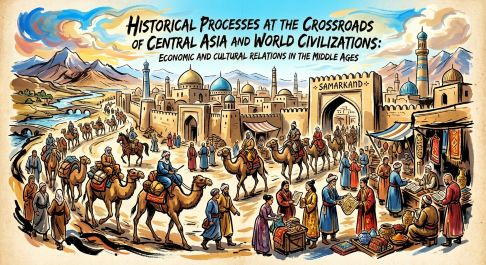
Exploring the historical processes, economic exchanges, and cultural interactions at the crossroads of Central Asia and other world civilizations during the Middle-Ages.
Ruxshona Rajabova| Uzbekistan
The Middle-Ages marked a transformative era in the history of human civilization, characterized by intensive interactions between diverse cultures, states, and nomadic-sedentary societies. Situated at the heart of the Eurasian continent, Central Asia served as a vital geographical and cultural bridge connecting East Asia, South Asia, the Middle East, and Europe. The historical processes unfolding in this region were largely defined by its unique geopolitical position, which facilitated profound economic interdependence and intellectual cross-fertilization. This study aims to investigate the multifaceted economic and cultural relations that positioned Central Asia as a central hub of medieval global connectivity, examining how commercial networks stimulated broader civilizational developments.
Scholars have emphasize that Central Asian trade was not merely an exchange of commodities such as silk, spices, and ceramics, but a complex mechanism of intercultural communication.
The Central Asian cities such as Bukhara, Samarkand, Merv, and Tashkent functioned as vibrant metropolitan hubs that sustained high levels of economic productivity and innovation. The findings indicate that:
The proliferation of caravanserai networks and standardized trade systems dramatically reduced logistical barriers, ensuring continuous commercial flows between China, the Islamic world, and European markets.
Economic transactions frequently catalyzed the transfer of crucial technologies, including papermaking, silk production techniques, and advanced agricultural irrigation methods, across distant civilizations.
Despite external geopolitical shocks and localized conflicts, Central Asian economic structures demonstrated remarkable adaptability, maintaining urban stability and craft production throughout successive dynastic transformations.
Central Asia’s historical significance extends far beyond its role as a passive transit zone. The economic prosperity generated through the Great Silk Road directly fueled a cultural and scientific renaissance within the region, laying the groundwork for advancements in astronomy, mathematics, medicine, and philosophy. The interaction between nomadic traditions and sedentary urban cultures created a dynamic socio-political ecosystem that influenced neighboring regions, including South Asia and the Middle East. Furthermore, the decentralized yet interconnected nature of these trade networks highlights how medieval globalization relied heavily on regional hubs for mediation and cultural translation.
In conclusion, the historical processes in medieval Central Asia demonstrate that the region was a foundational cornerstone of early global interconnectivity. Through robust economic cooperation, active trade along the Silk Road, and profound cultural exchanges, Central Asian civilizations significantly contributed to the shared heritage of humankind. The economic infrastructure and intellectual achievements of this epoch not only enriched local societies but also established enduring links between diverse global cultures that resonate in contemporary historical frameworks.
Read: Zhang Qian: The Pioneer of Silk Road
__________
Ruxshona Rajabova is studying at Bukhara International University of Uzbekistan