Through this award-winning novel, the author has attempted to illuminate a lesser-known chapter of Meerabai’s life
Meera
By Debasree Chakraborti
Place: Chittorgarh Fort
Today was unlike any other day. Evening had already draped itself in the colors of the local people, and besides, Saanjh had found herself bound in a new kind of bond with Pratap. The two of them were now sitting on the terrace of Rana Kumbha’s palace.
Though the sky was somewhat overcast, a gentle, sweet breeze was blowing. From the terrace, they gazed together at the distant horizon. At that moment, Saanjh shifted her veil from her right shoulder and said, “It doesn’t really get that cold here, does it?”
Pratap nodded with a sweet smile and replied, “Hmm, you’re right. The people of Rajasthan don’t really feel winter in that sense. But such weather, like the monsoon, has never been felt here before. It’s the effect of global warming — the seasons have changed. The clouds thunder in the sky…”
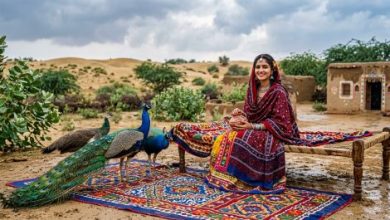
Just then, a peacock appeared on the terrace, crying out loudly, “kyaa-kyaa.” Both Saanjh and Pratap looked at the visitor, and the bird, too, observed the man and woman for a while. Then it moved a little distance away, spread its feathers, and began to dance. Soon, several peahens arrived, and surrounding him, they too began to dance.
Darkness had already settled over the Atabagan beside Rana Kumbha’s palace. For a few moments, Pratap and Saanjh gazed at one another — in these few days, they had come much closer. Today, nature itself seemed to revel in the glory of their newfound love.
Pratap said to her, “Saanjh, love can never find fulfillment without separation. Mirabai, in her lifetime, gave love its completion through the pain of separation. That is why today, I will tell you about one of the most important days of Mira’s life.”
Saanjh wrapped her red veil tightly around herself and said, “Now it feels a little chilly, doesn’t it?”
Pratap smiled and nodded in agreement: “That day too, in Chittorgarh the fort was shrouded in dark clouds, and since noon heavy rain had been falling. On that day, Mira was sitting in one of the chambers of this very palace where we are now seated, composing her songs.
Many years have passed since then. Mira’s songs have now become immensely popular all across India. Keeping pace with the flow of time, she has also composed commentaries on the Rasagovinda and Gita Govinda, which have gained high regard in scholarly circles. Mira spent her days immersed in worship, ragas, and musical devotion.
Meanwhile, the political landscape of India had changed significantly. Babur had triumphed in the First Battle of Panipat, and now his gaze was fixed upon Rajputana. To resist him, Rana Sanga had gone to war. These days, the forts of Mewar were nearly devoid of men, for all had gone to the battlefield.
During this time, Maldev Rathore united many Rajput rulers under the banner of Rana Sanga, forming a mighty alliance. Rana Sanga had believed that Babur, after defeating Ibrahim Lodi at Panipat, would remain in Delhi for a short time and then return. But that did not happen. Babur clung firmly to the throne of Delhi. Yet Rana Sanga’s dream was to seize the Delhi throne himself and unite the entire Aryavarta. Such a dream could not be abandoned so easily.
Rana Sanga’s vision was not unfounded, for soon enough Babur advanced toward Rajputana and captured the fort of Bayana. But Rana Sanga, too, was not one to sit idle. He forged a grand coalition against Babur. This mighty alliance included Prithviraj of Ajmer and Amber, Uday Singh of Bundi-Bagar, Kalyanmal of Bikaner, the rulers of Gwalior, as well as several Afghan chiefs — all united under Rana Sanga’s leadership. On February 16, 1526, this confederacy laid siege to the fort of Bayana from all sides.
This battle, fought with the valor of the Rajputs, has secured a terrifying yet crucial place in the history of politics, not only of India but of the world. For Babur’s army possessed the knowledge of gunpowder and artillery.
Saanjh, our religion teaches us the message of non-violence. It is precisely because we have always lived by the principles of non-violence and forgiveness that our land has repeatedly fallen prey to foreign invasions. Several centuries before Rana Sanga, Atisha Dipankar is said to have gone to Tibet in search of the formula for gunpowder, but he never returned. My belief is that Indians once knew the secret of gunpowder, but deliberately destroyed it It might not have been so. Had we known the use of gunpowder at that time, perhaps we would not have faced such a tragic fate.
But let that be. Let me return to the Battle of Bayana. That day, facing the artillery of Emperor Babur, the Rajput army fought with heroic valor. It is said that during that time nearly every household in Rajputana had been rendered almost devoid of men.
Raising a storm across the arid lands of Rajasthan, the Rajput forces broke through the main gates of Bayana and entered the fort. Then began an unequal struggle. By the end of the battle, thousands of Rajput soldiers lay dead, and above their corpses fluttered the saffron flag. For Emperor Babur, this defeat was one of great humiliation. Despite having the knowledge of gunpowder, in this war thousands of his soldiers had fallen to the swords of the Rajputs, who were almost weaponless in comparison. His army could hardly accept being vanquished at the hands of such foes. Many of his men even wanted to abandon India in the face of this adversity.
But at such a moment, Emperor Babur proclaimed a jihad. He would not rest until this insult was avenged. Moreover, he could not simply surrender the throne of Delhi.
Within about a month, Emperor Babur reorganized his forces and, on March 17, 1527, declared war against the Rajput confederacy on the plains of Khanwa near Bharatpur. At that time, Rana Sanga had returned to Chittor to rest. One night, however, four chieftains rode their horses in haste and arrived at Chittor. They informed him that Emperor Babur was preparing for battle on the plains of Khanwa. If the Rajputs did not ready themselves at once, they would have no choice but to accept servitude under Babur.
Rana Sanga wasted no time. That very night he sent word to the other rulers of Rajputana, inviting them to Khanwa. Truly, this was a battle for the freedom of Rajputana, indeed of the entire Aryavarta. And so, as soon as the Rajput kings received the summons, they advanced with their armies and encircled the Khanwa plains from all sides. A fierce battle began.
As the Rajput soldiers advanced, the cannons roared under the command of Ali and Mustafa. Yet Rana Sanga was undaunted. With immense vigor he pressed forward into the thick of battle. There, Emperor Babur employed the tactic of tulughma — launching a surprise attack from the rear. Rana Sanga, mounted upon his elephant, had advanced deep into the battlefield when suddenly a cannonball landed right in front of his elephant Rana was thrown off the elephant’s back and fell to the ground. The other Rajput chieftains carried him away from the battlefield to the camp at Baswa. There, treatment was given to Rana Sanga, and when he regained consciousness, he was informed that Emperor Babur had now declared war on the plains of Kalpi near Chanderi. Rana Sanga ordered the Rajput leaders not to waste any time and to march toward Kalpi. In that battle, the Rajput forces suffered a crushing and helpless defeat at the hands of Babur.
When the news of the defeat was conveyed to Rana Sanga, he was shattered in heart and spirit, and became speechless. Yet he could not be left behind in the war camp in such a condition. Somehow, with continued treatment, he was made somewhat better and then taken back to the fortress of Chittor. There, the royal physician began his treatment with full devotion.
Every evening, Meera would come to her Bapu Sa with the offerings (prasada) of Kumbh Shyam. In the dim room, a torch burned in one corner of the wall, and in that flickering light shone Rana’s two eyes. Wordless as they were, those eyes spoke volumes. Meera understood the language of those eyes. It was unbearable to witness the plight of a wounded lion. Those very eyes had once dreamed of uniting the whole of India, and now Meera saw those dreams drowning in the flood of defeat and humiliation.
She would touch the flowers of Kumbh Shyam’s offering to her Bapu Sa’s head and chest, stand silently by his side for a while, and before leaving, she would say:
“Bapu Sa, you will recover very soon. Just a few more days — you’ll see, everything will be as it was before. Besides, you needed some rest. So take this rest, for even the body needs it. Afterward, you’ll find yourself with even greater strength, ready to move again toward fulfilling your dream.”
According to the royal physician’s instructions, no one was allowed to remain in Rana’s chamber for too long, as there was a high risk of infection. So Meera did not linger there. Others too rarely came. Thus, Rana lived almost a solitary life. Yet, in his heart, he longed to recover quickly and avenge the defeat at Khanwa. With the force of his willpower and with Meera’s Giridharji’s blessings, Rana Sanga soon recovered. The news of his recovery quickly spread across the land The news spread across Mewar. Meerabai too was overjoyed and offered food (bhog) to her Giridharji. But light always carries its shadow alongside. Many could not tolerate the fact that Rana had recovered so quickly. Whispers began to circulate around the fort of Chittor — “How much this old man still clings to worldly pleasures! Otherwise, whoever returns from the very mouth of death?”
Unless Rana died, Ratan Singh could not ascend the throne. On the other hand, Dhanbai had thought that this time Rana would not return, and afterward her own son would become Rana, and she would be crowned the queen mother. For her son’s coronation, she had even ordered valuable garments and ornaments to be prepared. But just then, word reached her that Rana Sanga had summoned his ministers to his chamber and was already making plans for the next war.
Queen Dhanbai thought to herself: “Oh, there will indeed be a war, but it will be under Ratan Singh’s leadership. This old king must not go on ruling forever. If he insists on clinging to power even at the age of death, it will not be for the welfare of the subjects either. So, Ranaji, now you must take rest — whether you wish it or not.”
That night, Queen Dhanbai appeared at Ranaji’s palace, adorned in his favorite blue lehenga and white pearl ornaments. Everything had already been arranged. Once the queen mother arrived, the guards of that palace were replaced with Banbir’s men.
After a long time, in the midst of the palace’s play of light and shadow, Rana received his beloved queen Dhanbai, as though he had gained the full moon in his hands. For his supper, the queen had brought dishes prepared in her own palace, including his favorite kheer.
That night the skies of Chittor grew heavy with dark clouds. To have his queen by his side on such a night, Rana felt his life was truly blessed. Queen Dhanbai herself arranged the platter and fed Rana with her own hands. From outside, the rumble of clouds entered through the windows, accompanied by a cool wind, making the flames of the torches flicker. Smiling, the queen fed morsels to Rana, while Ranaji gazed intently at his beloved wife. Having returned from the jaws of death, to be gifted such a night felt to him like a blessing of the gods themselves.
When the meal was over, the queen washed and wiped Rana’s face with her own hands. Then came Rana’s favorite dish — the kheer, prepared lovingly by Dhanbai herself Most beloved. But was it really right, at his age, to eat kheer so late at night? Ranaji thought this for a moment, but the next instant he reassured himself — having escaped such great peril, no further danger could possibly touch him now. Besides, there was a different kind of plea in Dhanbai’s eyes tonight — and that plea could not be denied. Whatever may come, every single moment of this night must be lived with all his heart and soul.
The moment the kheer touched his lips, Rana felt something unusual — the taste tonight was completely different from all the other times. But how could that be? Perhaps, after consuming so many medicines these past days, his palate had lost its sense of taste. The kheer was not yet finished when he suddenly began to feel unwell. His chest and stomach started burning, then came the violent vomiting of blood. His entire body arched upward from the bed like a drawn bow.
Queen Dhanbai stood in one corner of the chamber, watching her husband’s death as though she were a neutral spectator. Husband — perhaps that word is misplaced here, for in the face of ambition for power, every relationship had become worthless. Besides, her marriage with Rana had always been a political alliance; there had never been any space for affection or sentiment in it — at least not from her side. Despite all her virtues as a woman, she had never been able to become the Rana of Jodhpur. Instead, her father had married her off to an old man. Thus, from the very beginning, a thirst for power and a desire for vengeance had burned within her. If she herself could not be Rana, then her son Ratan would be the ruler of Mewar — this dream she had carried in her heart all her life.
Outside, a storm raged with torrential rain. After a long struggle, as Rana’s body gradually turned lifeless, a sudden gust of wind blew in and extinguished the torchlight. Darkness engulfed the chamber. From within that darkness, the faint sound of anklets was heard. Queen Dhanbai slowly stepped out of Ranaji’s palace.
The news of Maharana Sanga’s death began to dissolve into the darkness of night. The flow of time itself seemed to halt, waiting for the dawn of the next day.
Such monsoon days were Meera’s great delight. During the rains, a sweet fragrance would drift from the orchards, and peacocks would dance. In such an atmosphere she would It could give rise to many new ragas in her heart. While gravely ill, Rana Sanga had asked her to take refuge in the Kumbhalgarh fort. For he believed that if he were to die, Meera’s life would not be safe in the Chittorgarh fort. But Meera had no desire to leave, for this palace, the orchard, the peacocks, and the hills of Chittor— all of these felt like her own kin. To live away from them was impossible for her. And so, she stayed on in Chittor.
Today, in Raag Malhar, Meera composed a remarkable song:
“Clouds drift in the monsoon sky, the beloved season of Saawan.
My heart surges with joy in Saawan,
I hear the footfall of Hari’s coming.
The winds roar, lightning flashes across the horizon,
Tiny drops of rain pour from the clouds,
Cool breezes soothe the soul.
Meera’s Lord, Giridhar Nagar,
Let us sing of bliss and festivity.”
At that very moment, a guard came running with news — Rani Sa, Rana-ji has departed from this world.
It was as if the sky itself fell upon Meera. A dreadful vision of the future suddenly appeared before her eyes. Karmetbai had taken Udai and Uda to seek refuge in the Ranthambore fort, Queen Jhali had already passed away, and Kuwar Bai was gravely ill — so no wailing or mourning could be heard from her palace. Meera understood the character of everyone within this fort. Ratan Singh’s mother would not weep, for she had never held any affection or emotion for Rana-ji. His death only meant that her son Ratan Singh would now become the Rana — news that brought her nothing but delight. From her palace, therefore, no sound of grief arose.
A deep fear gripped Meera. Since her arrival in Chittor, this was the very first time she felt such fear. For she knew her Bapu Sa had recovered completely, and at such a time, his sudden passing away was something her heart simply could not accept. Meera was certain that behind this There was a deep conspiracy behind it. Without waiting any longer, Meera ran toward Rana Sanga’s palace.
By then, the ministers, high-ranking officials, and Rajput chiefs had already gathered there. From a distance, Meera saw Rana’s body, wrapped in a white shroud, laid upon his bed. But the body was lying in a completely contorted posture. In a natural death, the body does not twist in such a manner. Slowly stepping closer, Meera could now see him clearly. Her Bapu Sa’s entire body had turned bluish — just like the discoloration caused by a snakebite. But how could a snake have entered inside the fort?
Soon, the mourning women arrived, beating their chests and wailing loudly. Meanwhile, preparations were being made to send the ailing Queen Kuwar Bai to the funeral pyre as sati. Since none of the other queens were willing to become sati, it was inevitable that the first wife of the Rana would have to. Entering her mother-in-law Kuwar Bai’s palace, Meera found her lying unconscious — and yet, in that helpless state, she was being prepared for sati. There was no room for protest, for if anyone dared to raise a voice, the enemies would burn her alive as well. In such a situation, Meera assumed the role of a silent observer. For now, both her strongest pillars of support in Chittor — Rana Sanga and Rajmata Jhali Rani — were gone. From this moment on, whatever she had to do, she would have to do surrounded by enemies. There was no other way.
The Rajput chiefs all assembled, and before sunset that day, Rana Sanga was cremated at the royal cremation grounds of Chittor, along with his first wife, Rani Kuwar Bai — the mother of Bhojraj — who was burned alive on the pyre as sati.
Pratap said, “Saanjh, ever since coming to Chittor, circumstances had made Meera Bai extremely hardened. For a Vaishnav devotee like her, to endure political conspiracies, violence, and malice was no less than a sin. And it was this heinous sin whose consequences the people of Chittor would later be forced to bear. The death of Rana Sanga marked the end of an era in the history of Rajasthan and Aryavarta. After his cremation, a dark shadow of grief fell across the entire Chittor. That night, within the fortress of Chittor, Meera Bai was left in the most helpless state of her life.
Pratap went on with his story, and Saanjh, through the power of her imagination, began to see those scenes unfold vividly before her eyes.
She saw the Meera Mahal shrouded in darkness, with only a single lamp burning before Giridharji. The room was otherwise empty. Suddenly, in the silence of the night, footsteps echoed. Then a shadow fell across Giridharji’s idol — someone had entered the room. In the darkness, the figure could not be clearly seen, only its presence could be felt. After remaining quiet for a moment, the newcomer spoke, “There is news, Rani Sa.” From another dark corner of the room, Meera’s voice emerged, “Come to me, Mita. These things must not be spoken loudly, for even the walls have ears.”
It became clear that the one who had arrived was Mita, one of Meera Bai’s most trusted maids.
Saanjh’s awareness slowly moved alongside the maid toward that dark corner. Having been in the darkness long enough, Saanjh could now see everything clearly — Meera Bai was sitting, leaning against the stone wall, her thick black hair spread like clouds. In a soft voice, Meera said, “Mita, what you are about to tell me — I already know.”
After letting out a deep sigh and remaining silent for a while, Meera added, “Yet I wish to hear it once from your own lips. Speak.”
Mita said, “Rani Sa, the night before last, a snake charmer was summoned to the palace of the middle queen. One of my friends works there as a cook. She told me that the morning after the snake charmer arrived, the Rani herself ordered that the meals would be prepared as usual, but she would personally make kheer for the Rana. My friends were not surprised, for it was well known that the Rana’s favorite kheer was always prepared by the middle queen herself. But while preparing the kheer, Ranima ordered everyone else to leave the kitchen. Though all others left, my friend did not — she remained in another part of the palace. Rani Sa, what can I hide from you? The kheer made by the middle queen is nothing short of nectar. So whenever she prepares it, my friend secretly scrapes a little from the bottom of the pot to take home for her own son. My friend thought the queen had finished making the kheer, and without waiting for her orders Instead of leaving, as she was about to approach the kitchen, she saw the queen mixing something into the kheer. By then, night had just descended upon nature, and in the darkness lit only by torches, my friend, clad in black, easily concealed herself. For you know well, Rani Sa, no one spares a witness to the vile politics of the palace. This is all that I know.
Meera said, “Mita, I have already told you that I know what has happened to Bapu Sa. Very well, now you may go — and tell your friend to behave as normally as possible, for any unusual conduct on her part will not bode well for her.”
Pratap paused for a moment before continuing:
“On the third day after Rana Sanga’s death, the entire fortress of Chittor adorned itself as if for a bride. From Jodhpur, the Rathores arrived in Chittor with elephants, horses, camels, and a grand procession laden with priceless gifts. The Rajput chiefs who had come to Chittor at the time of Rana Sanga’s death all remained there. The finest cooks of Chittor began preparing a variety of exquisite dishes. Just three days earlier, the fortress had witnessed the mournful cries of the professional wailing women, but now, in their place, dancers and musicians had been invited. From morning, the Rathores immersed themselves in joyous celebrations. This was, after all, the day they had long awaited. What could be a greater joy than the establishment of Rathore power from Jodhpur over Chittor!
The newly widowed Dhanbai was adorned with priceless ornaments and garments. As the maids dressed her, the marks of a conqueror could already be seen upon her face and eyes. From the royal court echoed the sound of trumpets, accompanied by the chanting of sacred hymns. In the presence of the Rajput chiefs and the Rathores of Jodhpur, Ratan Singh was enthroned as the ruler of Mewar.
While streams of celebration flowed within Chittor, the other side of it was shrouded in deep darkness. The common people of Chittor neither participated in this festivity nor desired to — instead, they expressed fierce condemnation. Meanwhile, in the ancient palace of Rana Kumbha, Meera Bai sat within, beginning to arrange her own pieces upon the board. Surrounded by enemies, she began preparing a chakravyuh of her own. But Meera’s vision was far more profound. She did not wish to bind herself within petty gains or narrow self-interest. She knew very well that today Those who are enemies today may one day take the place of friends. For no event, no circumstance, nothing is permanent—nor is any particular emotion everlasting. Therefore, it is not right to consider someone an enemy by judging a single moment. And so Meera took her time; she gave both herself and Chittor time for change to unfold.
Pratap said, “Since Ranaji’s death, Meera spends most of her time at Giridharji’s temple, mingling all day long with the common people. Now the Rana of Mewar is Ratan Singh. Since his enthronement, Meera has not visited him even once. Because of this, Ratan has been harboring deep resentment. One day, Banvir told him, ‘If you truly want to rid Chittor of enemies, then Mirabai must be imprisoned.’”
Ratan Singh replied, “I think the same. Mirabai has grown far too arrogant. Since I became Rana, she hasn’t come to see me even once.”
Banvir said, “Set aside such talk. The real danger is that Mirabai is steadily becoming more and more popular among the common people. This is extremely harmful for you, because at any moment Mirabai could incite rebellion in Chittor. Therefore, she must be imprisoned at once. And don’t take this the wrong way, Ratan—but these days you have been making many poor decisions. I feel you don’t trust me anymore. Otherwise, you would at least ask for my advice once in a while, instead of making rash decisions on your own.”
Ratan Singh was taken aback, as though struck by lightning. He said, “What wrong decisions have I made? What are you talking about?”
With a crooked smile, Banvir replied, “Even after your engagement to the princess of Amber, you failed to break off the marriage arrangement. Now Sujamal of Bundi—the brother of your junior queen, Karmetbai—is about to marry that very princess. Do you realize what that means? Amber and Bundi are about to unite as a combined force. On the other hand, Queen Karmetbai is said to be seeking the help of Emperor Babur himself in order to place Vikramjit upon the throne. Do you see now the peril you are in? And what’s more, the common people of Chittor believe that we poisoned Rana Sanga to death. That means rebellion could break out at any time.
Maldav was also present in that chamber, and he said, “First, let Mirabai be imprisoned.”
Meanwhile, Banvir sent troops to Merta to capture Meera’s uncle. He convinced Ratan Singh that Biramdev was about to ally himself with Karmetbai, and therefore he must be arrested as quickly as possible. Meera, though aware of everything, remained silent.
Ratan Singh said, “It seems she has lost all interest in worldly life—that’s why she stays so quiet.”
Banvir replied, “No, no—her mind hasn’t risen above worldly concerns. She’s very shrewd. She knows that if she sends a messenger to Merta now, she will be exposed.”
But this political cannon that Banvir had fired suddenly turned back against him. For as long as Maldev, as the heir-apparent of Jodhpur, was obeying Banvir’s instructions, the Rana of Jodhpur, Rao Ganga, could not accept it. Nor did he approve of this move against Merta. After all, the Rathores of Merta were his close kin. So he ordered Maldev to return.
Ratan Singh, however, was displeased with the withdrawal of troops from Merta. He thought to himself, Recalling the soldiers means bowing our heads before Merta—how can that ever be possible!
At this, Banvir said, “Rao Ganga will soon have no time to interfere in the affairs of Merta. Because his uncle, Kumar Sekhaji, is preparing to attack Marwar with his forces within a few days, and along with him are coming Amir Khan of Nagaur and Rao Jetsi of Bikaner.”
Hearing this, a smile spread across Ratan Singh’s face. At that very moment, Banvir’s eyes blazed, and staring at Ratan Singh he said, “Did you know that the Mughal emperor Babur has sent Mirabai a necklace of diamonds? So this is no time for rejoicing. (Continues)
Click here for Part-1, Part-2, Part-3, Part-4, Part-5, Part-6, Part-7, Part-8, Part-9, Part-10, Part-11, Part-12, Part-13, Part-14, Part-15, Part-16, Part-17, Part-18, Part-19, Part-20, Part-21, Part-22, Part-23, Part-24, Part-25, Part-26, Part-27, Part-28, Part-29,
_______________
 Debasree Chakraborti is a renowned novel writer of Bengali language. Based in Kolkata, West Bengal, India, she has done Master’s in Modern History from the Kolkata University, and authored some thirty books, mostly the novels, with historical perspective and themes. Her novel is ‘Maharaja Dahir’ that covers the history of Sindh from 662, the year of first attack on Sindh by the Arab armies till date, was published last year and translated by Nasir Aijaz into Sindhi language.