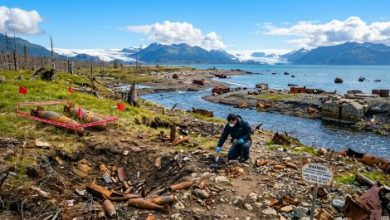
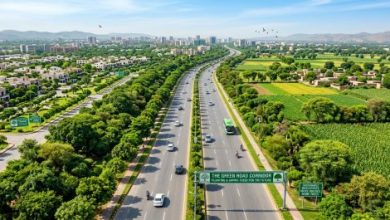
Despite protections, illegal mining, construction, and encroachment have caused extensive damage to Khirthar National Park’s landscape and ecosystem
Khadija Haider
Khirthar National Park (KNP) is a protected landscape spanning parts of Karachi, Dadu, and Jamshoro districts in Sindh. Its wildlife and natural resources are safeguarded by a comprehensive legal framework. Despite these protections, illegal mining, construction, and encroachment have caused extensive damage to KNP’s landscape and ecosystem. This piece examines why protections have failed in practice and argues for the application of the Polluter Pays principle to secure redress and restoration.
Legal protections and their scope
International and national status: KNP is listed as Category II protected area by the International Union for Conservation of Nature (IUCN).
It is designated under Pakistan’s protected areas framework and referenced in the Sindh Wildlife Protection, Preservation, Conservation and Management Act 2020 (Wildlife Act), with Khirthar National Park specifically listed as a protected national park.
Provincial laws and regulatory regime: The Sindh Wildlife Act, 2020 prohibits killing wildlife, destruction of flora, pollution of water sources, and damage to the natural infrastructure of protected areas such as KNP.
The Sindh Environment Protection Act, 2014 requires an Environmental Impact Assessment (EIA) and public hearing, with a formal approval process prior to construction. In protected areas like KNP, construction and mining are generally prohibited, with or without EIA compliance, to preserve the pristine environment.
The Reti Bajri Act (Prohibition of Taking Minerals Including Reti Bajri from any Land, 2003) requires a license for mining; however, licenses cannot authorize activity within KNP, whose sand and gravel resources are not open for extraction.
 Administrative boundaries and buffer zones
The Khirthar complex includes: (1) Khirthar National Park (Karachi and Dadu, 308,733 hectares); (2) Mahal Kohistan Sanctuary (Dadu and Jamshoro, 70,577 hectares) contiguous to KNP to the south; (3) Hub Dam Wildlife Sanctuary (Karachi, 27,219 hectares) in the southwestern area of KNP; and (4) Sumbak, Sujan, Eri, and Hothiano (40,631 hectares) in Dadu and Jamshoro, declared as game reserves east of KNP.
The protected area’s buffer zone extends up to three miles around core habitats, containing important archaeological and cultural sites.
Geography, biodiversity, and cultural significance
The Khirthar landscape supports a diverse array of flora and fauna, including Sindh Ibex, vultures, migratory birds, and various reptiles and amphibians.
The region contains valuable minerals, notably reti bajri (sand and gravel), and hosts historically significant monuments such as Ranikot Fort (one of the world’s largest forts) dating back to ~3500 BCE.
Local communities, including Kalmatis, Gabols, Jokhios, and others, rely on the park’s buffer zones for sustainable farming and pastoral activities, and they maintain a cultural and ecological relationship with KNP.
 Threats and governance failures
Illicit extraction and encroachment: Real estate developers, notably Bahria Town Karachi Limited (BTKL) and Defence Housing Society (DHS), have pursued expansion around KNP, drawing water from sub-surface aquifers and altering natural hydrology. Dawn (2022) reports that BKTL extracts approximately 1.77 million gallons per day from 59 boreholes, straining water resources essential for wildlife, agriculture, and nearby communities.
Damaging activities include diverted drainage, altered river flows, and construction that encroaches on KNP’s boundaries and buffer zones.
Regulatory capture and non-enforcement
Various Sindh agencies, including SEPA (Sindh Environmental Protection Agency) and relevant wildlife authorities, have been criticized for failing to enforce protected-area protections, often through a permissive stance toward developers and mining interests.
Court orders and judicial scrutiny exist (e.g., a 2018 Mehmood Akhtar Naqvi v Malik Israr matter and related 2019 implementation bench actions), but enforcement has been inconsistent, with ongoing encroachment and non-compliance by BKTL and associated actors.
 Historical and cultural loss
In addition to biodiversity loss, KNP’s buffer zone contains multiple heritage and archaeological sites at risk of degradation from illegal activities and infrastructure development.
Lessons from comparative jurisprudence
Indian jurisprudence on sand mining and environmental restoration
In Khirthar Petition 2024 (para 10) and related cases such as Khirthar Bajri Lease LOI Holders Welfare Society v. State of Rajasthan, the Indian Supreme Court underscored:
The State must enforce statutory clearances and taxes, and ensure restoration costs are accounted for in compensation.
The Polluter Pays principle requires absolute liability for environmental harm, including restoration of degraded ecosystems.
National Green Tribunal (India)
In Shri Hazi Arif v. State of Uttar Pradesh (2014), the NGT emphasized demolition of encroachments within bed and buffer zones of protected areas, reinforcing robust protective measures for vulnerable ecosystems.
Proposed remedies and policy stance
Apply the Polluter Pays principle to Khirthar
Hold BKTL and other violators financially accountable for restoration, erosion control, biodiversity recovery, and infrastructure rehabilitation within KNP and its buffer zones.
Require restitution that covers ecological services lost due to mining and encroachment, including water-resource restoration, soil rehabilitation, and habitat restoration for endemic species.
Strengthen enforcement and governance
Reaffirm and enforce buffer-zone protections and core-area boundaries; ensure no mining, construction, or water-diversion activities are allowed within KNP without explicit, legally mandated approvals and independent monitoring.
Reinstate and strengthen check posts, boundary signage, and patrolling by wildlife and forest authorities; address signs and boundary breaches that have been neglected or removed.
Improve transparency and accountability
Mandate public reporting of licenses, weight-dispatch slips, and water extraction metrics for all projects adjacent to KNP.
Ensure that EIA processes are robustly conducted for any development in the broader park region, with public hearings and independent impact assessments.
 Learn from regional practice
Consider adopting procedural steps from the Indian jurisprudence on regularized mining, royalty payments, and environmental restoration in concessional agreements, adapted to Sindh and Pakistani law.
Restore public trust and environmental justice
Pursue a policy that balances development with ecological integrity, ensuring the long-term livelihoods of indigenous communities, biodiversity, and cultural heritage are preserved.
Closing thought
As the Nepali Supreme Court quote cited in this piece reminds us, “while using nature, utmost caution should be taken … No one has the right to abuse nature and damage it to the extent that it can never return to its original form … just to recover a trade deficit.” The Khirthar conservation case calls for decisive action grounded in the Polluter Pays principle, with accountability and concrete restoration to secure a future for this unique landscape and its people.
References
- Zaheer MD Khan, Ali Syed, Ghalib Naser, Abdur Razzaq Khan, (2013). Current habitat, distribution, and status of the mammals of Khirthar Protected Area Complex, Sindh. [PDF document]. (PDF) CURRENT HABITAT, DISTRIBUTION AND STATUS OF THE MAMMALS OF KHIRTHAR PROTECTED AREA COMPLEX, SINDH]
- Facebook. [Unexplored Sindh]. Retrieved [2012], from [Facebook]
- MAG The Weekly. Kirthar National Park: A hidden treasure in Pakistan’s wilderness. Travel Diaries – MAG The Weekly. Retrieved from https://magtheweekly.com/detail/22750-kirthar-national-park-a-hidden-treasure-in-pakistans-wilderness
- InShort News. (n.d.). Kirthar: A natural sanctuary in Sindh facing challenges. InShort News. Retrieved from https://inshort.pk/travel/kirthar-a-natural-sanctuary-in-sindh-facing-challanges/
- Syed, N. (2022). Special report: Wasteland foretold – Pakistan. Dawn. Retrieved from https://www.dawn.com/news/1681131
- Enright, N. J., Miller, B. P., & Akhter, R. (2005). Desert vegetation and vegetation-environment relationships in Kirthar National Park, Sindh, Pakistan. Journal of Arid Environments, Volume 61, Issue 3, 2005, Pages 397-418,(https://www.sciencedirect.com/science/article/pii/S0140196304002095
- Yusafzai, A. (2025, January 13). Off-limits: Kirthar National Park. Courting The Law. Retrieved from https://courtingthelaw.com/2025/01/13/commentary/off-limits-kirthar-national-park/
Read: The Nature, Culture and Adventure of Khirthar National Park
________________________
 Advocate at Green Chamber, Climate Action Center, Karachi Sindh