Stories of Karachi’s Taxi Drivers from 1993 to 2000
Zaffar Junejo
[Author’s Note: I joined a non-government organization in mid-1993. In those days, we were frequent travelers to other Asian countries, and during that period I maintained a diary. I once showed the notes to Muhammad Ibrahim Joyo — the legendary scholar, translator, and intellectual giant of the Sindhi world — who suggested categorizing the entries by theme and getting them published. He recalled that long ago, perhaps in 1955, the Sindhi journal Mehran had launched a similar idea titled ‘Hik Deenh Ji Ghaleh’ (The Story of a Day), even offering a prize for it. He himself had submitted the first story, he told me with a smile, just to set a standard for other writers. Later, Maulana Ghulam Muhammad Girami, a scholar of high standing and journalist; Shamsher ul Haidri, a distinguished Sindhi poet, journalist, and playwright; and Siraj ul Haq Memon, an iconic novelist, linguist, and journalist, all contributed their observations of a single day. These writings were published until 1968.
I agreed with Joyo Sahib that I would group the write-ups by subject and get them published, but I failed to do so. Recently, I sat down to organize my notes. I found various entries about the taxi drivers of Karachi city. Some were very brief and incomplete; others were short but held a finished truth. I have chosen five stories from each year, all of them gathered from the drivers of those cars. In total, there will be thirty-five stories covering the period from 1993 to 2000.]
The Beep and the Heart
The morning air smelled of dust and damp concrete. Nine o’clock on a Sunday. The February sun stayed low behind a gray rim, a short, fleeting Sindhi spring caught between seasons.
I walked down the stairwell of the flats. Outside, the sea breeze came hard from the west-southwest. It felt sharp, colder than yesterday. Overhead, three white clouds moved across the blue like solitary boys kicking a football across a dry field. The wind slowed. The clouds thickened, layered, and turned the sky into a flat sheet of slate.
Winter had come back.
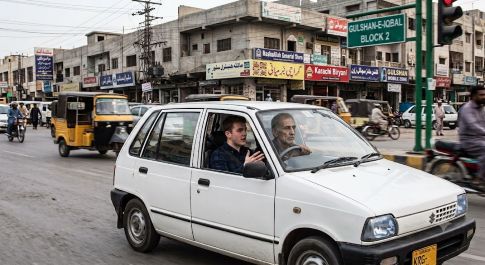
A clean white Mehran sat by the curb. No yellow paint. No taxi sign. I stopped, my boots grinding on the gravel, hesitating. Inside, the driver shifted. A hand lifted, fingers gesturing a brief, silent invitation toward the passenger door.
“Shaheen Public School?”
The driver nodded once. “Yes.”
The interior smelled of fresh vinyl and factory adhesive. Clear plastic crinkled under me on the seats. The dashboard shone, immaculate and new.
“How much?”
“Two hundred rupees.”
“Good.”
The sedan pulled into the stream. The driver kept eyes darting from side mirrors to the swarm of motorbikes, rickshaws, and the high, roaring grilles of minibus transport. He braked hard as a politician’s pickup truck cut the lane.
“New car.”
“Five months and six days,” the driver said. He did not look over. His eyes stayed on the brake lights ahead.
“You count the days closely.”
“The bank counts them.” The driver adjusted his grip. “The bank makes a man exact.”
“A heavy installment?”
“Fifteen thousand. Every tenth of the month. I need seven hundred rupees a day.” He shifted into third. “If the city stays quiet, it is easy. But the city does not stay quiet.”
“No. It doesn’t.”
“When the rumours start, or the strikes, I park it. If a brick flies, the glass breaks. If they burn it, I still owe the bank. So I wait. The next day I drive double. I burn the petrol looking for faces on the corners. I burn the profit just to find the fare.”
“Does it pay?”
“It fills the gap. Eighty percent of the time, I am just filling yesterday’s hole.”
The wind buffeted the side windows, a steady, low whistle.
“You look tired.”
“My calves ached yesterday. Like needles. I went to the clinic. The doctor took the blood and told me the sugar had found me.”
“You are too young for diabetes. Your father?”
“No one.” The driver struck the steering wheel with the flat of his palm. The plastic cracked loud. “This did it. Just this.”
The traffic slowed near a roundabout.
“Seven days before the tenth, the messages begin,” the driver said. His voice dropped, losing its edge, turning flat. “The phone sits on the dash. It beeps. First it is a reminder. Then it is a warning. Every time it beeps, my heart jumps against my ribs. My palms wet the leather. My throat tastes like ash.”
He stopped for a crossing school bus. His fingers tapped a rapid, uneven rhythm on the wheel.
“There are two of us from the same block who took the bank’s money for cars. Now both have the sugar. When the first week of the month comes, my wife stays in the kitchen. My little girl looks at me from the doorway and will not come near. I am a different man then. I am sharp, like shattered glass.”
“Karachi is vast,” I said, looking out at the gray sprawl. “There are always people.”
“The city is too big,” the driver said. He turned the corner by the market stalls. “But it is sick. It is a wounded animal now. It bites its own limbs to stay alive.”
“What will you do?”
“Find a buyer. Take a loss. Give the car back to the bank.”
The yellow brick facade of Shaheen Public School appeared beyond the perimeter wall.
“Here,” I said. “Near the flats.”
The sedan slid to the curb and stopped. The engine idled, quiet and smooth.
I reached forward and placed two hundred rupees on the clean vinyl dashboard. The driver took the bills, folded them once without looking, and tucked them into his vest pocket. He gave a single, tight nod.
I shut the door. The plastic inside crinkled one last time. The white car merged back into the dust and the gray February wind, moving toward the next corner.
__________________
 Dr. Zaffar Junejo has a Ph.D in History from the University of Malaya. His areas of interest are post-colonial history, social history and peasants’ history. He may be reached at junejozi@gmail.com