Stories of Karachi’s Taxi Drivers from 1993 to 2000
Zaffar Junejo
[Author’s Note: I joined a non-government organization in mid-1993. In those days, we were frequent travelers to other Asian countries, and during that period I maintained a diary. I once showed the notes to Muhammad Ibrahim Joyo — the legendary scholar, translator, and intellectual giant of the Sindhi world — who suggested categorizing the entries by theme and getting them published. He recalled that long ago, perhaps in 1955, the Sindhi journal Mehran had launched a similar idea titled ‘Hik Deenh Ji Ghaleh’ (The Story of a Day), even offering a prize for it. He himself had submitted the first story, he told me with a smile, just to set a standard for other writers. Later, Maulana Ghulam Muhammad Girami, a scholar of high standing and journalist; Shamsher ul Haidri, a distinguished Sindhi poet, journalist, and playwright; and Siraj ul Haq Memon, an iconic novelist, linguist, and journalist, all contributed their observations of a single day. These writings were published until 1968.
I agreed with Joyo Sahib that I would group the write-ups by subject and get them published, but I failed to do so. Recently, I sat down to organize my notes. I found various entries about the taxi drivers of Karachi city. Some were very brief and incomplete; others were short but held a finished truth. I have chosen five stories from each year, all of them gathered from the drivers of those cars. In total, there will be thirty-five stories covering the period from 1993 to 2000.]
Back to Basics
For two years, Karachi had waited for rain. The clouds came from the Arabian Sea. They rose beyond the port and crossed the coast in slow black lines. The wind first brought salt. Then dust. Then the smell of wet earth, though the earth had not yet received a drop.
At half past five, my friends and I left the office.
The first rain was thin. It touched the face like a memory. A cool wind moved through the streets. The city looked younger under the early lights. Even the broken pavements seemed less tired.
We found a tea stall at the corner of Neelam Colony. It stood under a rusted tin roof. Beside it, a man fried pakoras in a black pan. Another arranged samosas behind a cloudy glass case. Oil hissed. Tea boiled. Rain tapped the roof.
It was the right place for such an evening.
We drank tea from small glasses. We ate pakoras with green chutney. We spoke of books. Each man carried a writer in his pocket. Yet The Structure of Scientific Revolutions held the table.
One friend warmed his hands around his tea glass. He looked at the rain beyond the stall.
“Revolution begins when an old order fails.”
I watched steam rise from the frying pan. The smell of gram flour mixed with wet dust.
The rain grew heavier. It came down in thick drops. We ordered another plate of pakoras. Then another round of tea. Nobody wished to leave. The stall had become a small country. Outside it, Karachi disappeared behind the rain.
At last, we stepped into the street.
Some friends found a shared taxi for North Nazimabad. I watched them leave. Their faces passed behind wet glass. The taxi turned at the crossing and vanished into the rain.
I stood alone.
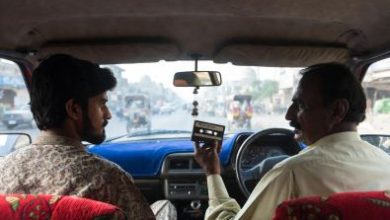
A taxi waited near the corner. Its yellow paint had faded. Water ran along its bonnet. I walked toward it. I bent near the driver’s window and wiped rain from my forehead.
“Salam. Gulshan-e-Iqbal?”
The driver looked at me. His hands rested on the steering wheel. His face had the calm look of a man who had seen many rains.
“Twelve hundred rupees.”
I stared at him. Water ran from my hair into my collar.
“Twelve hundred rupees?”
He nodded.
The rain strengthened. The street emptied. A donkey cart moved through the water. A rickshaw coughed near the crossing. A cart-puller bent under a wet sheet of plastic. The city had begun to withdraw into itself.
I had no choice. I looked once at the dark road and opened the rear door.
“Fine. Let us go.”
The taxi moved through Punjab Colony. Water gathered along the roads. The driver leaned toward his window. He watched the sky. He watched the rain as if it were an old enemy.
I sat silent. The fare stayed in my mind. After some time, I looked at his face in the rear-view mirror.
“Why have you charged so much?”
He kept his eyes on the road. His fingers tightened on the wheel.
“Rain.”
I frowned and looked at the flooded street.
“Rain doubles the fare?”
He glanced at me. The driver raised his left index finger. He looked ahead through the wet windscreen.
“First, you must see.”
I felt irritation rise. I leaned forward.
“See what?”
He pushed his seat back. He pulled the taxi over beside the footpath near Sunset Boulevard. He opened the door and stepped out. I watched him through the side mirror.
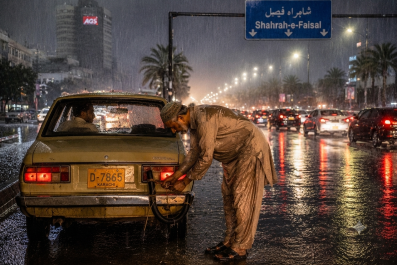
He took an old bicycle tube from the boot. He bent near the rear of the taxi. He pushed one end into the silencer. Then he tied the other end high under the bumper. The tube hung there like a small black snake.
He returned. He wiped his hands with an old cloth. He sat behind the wheel. I looked at the tube above the water. My anger weakened.
“You are a clever man.”
He smiled. Then he started the engine.
The taxi moved again. I watched the water break beneath the tyres. Streetlights trembled in the pools. The city seemed to float. Shops stood closed. Their shutters reflected in the water like old photographs.
“How long have you driven?” I asked.
He adjusted the mirror. His eyes remained on the road.
“Since General Zia.”
I looked through the wet windshield. The rain made every light distant.
“And how did Karachi manage rainwater in those days?”
He slowed the taxi near a flooded crossing. He watched the water move across the road.
“Natural waterways were open. Water had a path. It went to the sea.”
I looked at the roads, the houses, and the walls built where water once moved.
“And now?”
He shook his head.
“Now we closed the paths. We built houses. We built roads. We filled the drains.”
I nodded slowly. Rain struck the side of the taxi.
“We chained the water.”
He looked at me through the mirror. A small smile came to his face.
“Yes. Water is chained.”
I watched the rain sweep across the windscreen.
“And the rain?”
He pressed the accelerator gently.
“Rain comes to free it.”
The taxi entered a flooded road. Cars stood in long lines. Their engines ran. No driver dared to switch off the ignition. Water reached the silencers. Some cars shook. Some stopped. Others moved in zigzags toward the higher edge of the road.
The driver pointed ahead.
“Every vehicle fears the water. One engine stops. Then ten stop. Then the whole road dies.”
I watched a car stall near the median. Its driver stepped out into knee-deep water. He stood there with both hands on his head.
“You know this city well.”
The driver gave a short laugh.
“Bas, Saeen. Tajurba aahe. I have lived here for years.”
I looked at the water moving through the street like a lost river.
“What is the solution?”
He looked straight ahead.
“Back to basics.”
I leaned forward.
“What does that mean?”
He lifted one hand from the wheel and pointed toward the dark road.
“Make Karachi like the city of the 1970s.”
For a moment, I saw another Karachi. Fewer cars. Open drains. Long trees along the roads. Rainwater moving quietly toward the sea. A city that had not yet filled every empty place with concrete.
He looked at the water crossing the road.
“Open the natural paths. Let water go where it wants to go. Otherwise, every rain will become a problem.”
We arrived near my flat. The fare returned to my mind. I looked at my wet wallet. Then I looked at him.
“Will you make some concession?”
He turned toward me. A quick smile crossed his face.
“Fine. One thousand rupees.”
I laughed. He laughed too.
I paid him and stepped into the rain.
The road behind me had become a stream. The taxi moved slowly into it. Its bicycle tube rose above the water like a small black flag.
I walked toward my flat. One thousand rupees was not too much that night. In such rain, finding a taxi was luck.
__________________
 Dr. Zaffar Junejo has a Ph.D in History from the University of Malaya. His areas of interest are post-colonial history, social history and peasants’ history. He may be reached at junejozi@gmail.com