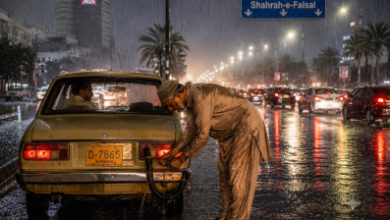
Stories of Karachi’s Taxi Drivers from 1993 to 2000
Zaffar Junejo
[Author’s Note: I joined a non-government organization in mid-1993. In those days, we were frequent travelers to other Asian countries, and during that period I maintained a diary. I once showed the notes to Muhammad Ibrahim Joyo — the legendary scholar, translator, and intellectual giant of the Sindhi world — who suggested categorizing the entries by theme and getting them published. He recalled that long ago, perhaps in 1955, the Sindhi journal Mehran had launched a similar idea titled ‘Hik Deenh Ji Ghaleh’ (The Story of a Day), even offering a prize for it. He himself had submitted the first story, he told me with a smile, just to set a standard for other writers. Later, Maulana Ghulam Muhammad Girami, a scholar of high standing and journalist; Shamsher ul Haidri, a distinguished Sindhi poet, journalist, and playwright; and Siraj ul Haq Memon, an iconic novelist, linguist, and journalist, all contributed their observations of a single day. These writings were published until 1968.
I agreed with Joyo Sahib that I would group the write-ups by subject and get them published, but I failed to do so. Recently, I sat down to organize my notes. I found various entries about the taxi drivers of Karachi city. Some were very brief and incomplete; others were short but held a finished truth. I have chosen five stories from each year, all of them gathered from the drivers of those cars. In total, there will be thirty-five stories covering the period from 1993 to 2000.]
First Giraeen, Then Friends
The weekend moved slowly. The day held its breath. Cold air came through the window. The sky looked clean. I had no work. I had no hurry. Time hung above the streets like a loose wire.
I wanted to see my friends in Makhdoom Bilawal Village.
A taxi stopped near the curb. The driver leaned across and opened the front door.
“Will you go to Makhdoom Bilawal Village?”
He looked at me in the mirror.
“Three hundred rupees.”
I nodded and sat beside him.
The taxi moved. He took a left turn, then crossed a blind intersection without slowing much. A bus horn broke behind us. He lifted one hand from the wheel and waved it away.
After a while, he looked at me. “You are going to meet friends?”
“Yes.”
“Your friends belong to your village?”
“No.”
He drove for some time. The road ran between shops, broken walls, fruit carts, and men standing under tea stalls.
“You work in the same office?”
“No.”
The taxi grew quiet. A radio played an old Punjabi song, ‘Mera Laung Gawacha.’ The driver tapped his fingers on the steering wheel, then he smiled.
“Relatives?”
“No. Not at all.”
He laughed softly. “In Gulshan and Johar there are buildings.” He paused. “Half-finished buildings.”
I looked at him. “You live there?”
“Yes. I live there with friends.”
“All from the same area?”
“Yes.”
“Where are you from?”
“Kot Addu.”
“So you are friends.”
“No. First we are giraeen. Then we are friends.”
His words stayed in the car.
“What is the difference between giraeen and friendship?”
He smiled. His face carried the calm pride of a man who had answered this question before. “Not every friend can be giraeen. But some giraeen can become friends.”
I looked at him and nodded. “That is a good definition.”
He grinned. “What do your giraeen do in Karachi?”
“Some drive rickshaws. Some work in construction. Some are helpers. Others do tel malsh.” He laughed at the last words, his shoulders shaking. The taxi moved over a broken patch of road.
We passed Makhdoom Bilawal Crossing.
For a moment, I wanted to explain to him about the friends I was going to meet. They were not my giraeen. They were not relatives. We did not work in the same office. We did not come from the same village.
But I kept quiet.
I wanted to tell him we shared a lot of other things. We shared old arguments. We shared anger at injustice. We shared hope for a better city. We shared the belief that people could still stand together.
The taxi entered Makhdoom Bilawal Village.
“Stop here.”
He pressed the brake. The taxi came to rest beside a narrow lane. I paid him. He took the notes and looked at me.
“Meet your friends.”
“I will.”
I stepped out into the cold evening. The taxi moved away.
Ahead of me were my friends. Our friendship had no village behind it. No family name. No office gate.
It stood on goodwill. It stood on a collective dream.
_________________________
 Dr. Zaffar Junejo has a Ph.D in History from the University of Malaya. His areas of interest are post-colonial history, social history and peasants’ history. He may be reached at junejozi@gmail.com