

Stories of Karachi’s Taxi Drivers from 1993 to 2000
Zaffar Junejo
[Author’s Note: I joined a non-government organization in mid-1993. In those days, we were frequent travelers to other Asian countries, and during that period I maintained a diary. I once showed the notes to Muhammad Ibrahim Joyo — the legendary scholar, translator, and intellectual giant of the Sindhi world — who suggested categorizing the entries by theme and getting them published. He recalled that long ago, perhaps in 1955, the Sindhi journal Mehran had launched a similar idea titled ‘Hik Deenh Ji Ghaleh’ (The Story of a Day), even offering a prize for it. He himself had submitted the first story, he told me with a smile, just to set a standard for other writers. Later, Maulana Ghulam Muhammad Girami, a scholar of high standing and journalist; Shamsher ul Haidri, a distinguished Sindhi poet, journalist, and playwright; and Siraj ul Haq Memon, an iconic novelist, linguist, and journalist, all contributed their observations of a single day. These writings were published until 1968.
I agreed with Joyo Sahib that I would group the write-ups by subject and get them published, but I failed to do so. Recently, I sat down to organize my notes. I found various entries about the taxi drivers of Karachi city. Some were very brief and incomplete; others were short but held a finished truth. I have chosen five stories from each year, all of them gathered from the drivers of those cars. In total, there will be thirty-five stories covering the period from 1993 to 2000.]
The Road to Jackson Market
The “Road to Jackson Market” exercise continued as an on-and-off activity in my life. I used to believe regular walking was enough. Age proved me wrong. My body demanded movement; my mind accepted the truth. Exercise was no longer a choice—it had become a necessity.
Those were different days. Long walks along Karachi’s footpaths were difficult. Public parks were few, and time was scarce. Home seemed like the only practical place to work out.
A friend offered a solution. “Go to Jackson Market. You will find exercise machines there. The prices are better than anywhere else.”
The suggestion stayed with me.
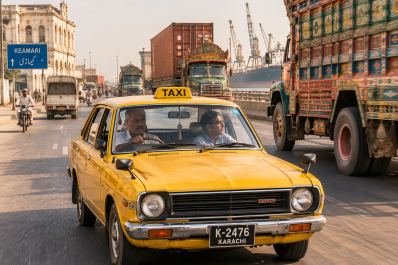
That evening, I stepped out of the office. The sun had begun its slow descent, but heat still floated above the road. A yellow taxi waited across the street. I opened the door and settled into the back seat.
“Jackson Market.”
The driver nodded. The engine growled, and the taxi rolled into the stream of traffic.
It was my first journey to Jackson. The roads toward Keamari were unfamiliar, and curiosity soon broke the silence.
“Do you know Jackson Market?”
The driver kept his eyes on the road as a decorated cargo truck thundered past us in the opposite lane. “Very well. It is the city’s old seaside bazaar.”
“What makes it old?”
“You have never been there?”
“No.”
His hands rested firmly on the steering wheel. “It is famous for smuggled electronics, customs-auctioned goods, imported bicycles, leather jackets, cameras, and household appliances. You can find almost anything.”
“Does it depend on luck?”
He smiled and tapped the faded leather jacket across his chest. “For example, look at this jacket. Good quality, small price.”
I looked at the cracked leather. Years of use had polished its surface more than any factory could.
“What is the fare?”
“Four hundred for Jackson, brother.”
I shook my head. “I belong to Karachi; I am not a tourist. Give me the real price. Two hundred and fifty.”
A loud laugh filled the taxi, and the engine rattled beneath us. “Sahib, heavy trailers own this road. One mistake and we become biscuits beneath their wheels.” He paused, another smile crossing his face. “Fine. Two hundred and fifty.”
The taxi gathered speed.
Keamari unfolded before us. Warehouses stretched across the port, rust covered old cranes, and salt drifted through the open window. The sea breeze carried a heavy mix of diesel, iron, and tidewater.
The driver slipped between giant cargo trucks. Each vehicle wore brilliant paintings. Mirrors glittered, chains swung beneath colorful bumpers, and brass bells danced with every bump. Massive tires rolled right beside us—inches separated steel from steel.
The taxi darted forward, and my hands tightened around the seat.
Colonial buildings appeared beside the road, their faded walls carrying the weight of another century. Broken balconies leaned toward the harbor, and old windows watched ships enter and leave.
The driver glanced into the rearview mirror. “You are buying a television or a bicycle?”
“Neither. I only want an exercise machine, if the price is reasonable.”
He released a long breath. “Jackson has changed.”
“What changed?”
“The oil terminal. The Karachi Port. New port infrastructure. Heavy traffic is everywhere now. Customers struggle to even reach the market.” Outside, endless trailers crawled toward the docks. Horns echoed across the harbor, and dust floated thick above the road.
He continued, “Still, no place beats Jackson. Air conditioners, refrigerators, washing machines, televisions, imported bicycles, cameras… every lane hides another bargain. But one piece of advice.”
I leaned forward. “What is it?”
“Do not buy from the shops near the entrance. They study your face, then they double the price.”
“Where should I go?”
“Walk deep into the lanes. Tell them your friend lives in the Jetty area. They may offer you the real smuggled discount.”
Before I could answer, he swung sharply left. The taxi squeezed through a narrow gap between trailers, the engine roaring.
Jackson Market appeared without warning.
Narrow lanes, crowded shops, hanging signboards, towers of cardboard boxes, and stacks of bicycles, refrigerators, air conditioners, washing machines, televisions, and cameras. Voices floated through the market like waves striking a harbor wall.
He pulled up beside the entrance. I handed him two hundred and fifty rupees.
He accepted the notes, a broad smile spreading across his betel-stained face. One playful wink completed the bargain. The taxi spun around in one smooth turn, and within seconds, it disappeared into the roaring port traffic.
I stood alone at the entrance of Jackson Market. The salty wind brushed my face. Somewhere inside those crowded lanes waited an exercise machine—and more importantly, another side of Karachi waited to be discovered.
_______________________
 Dr. Zaffar Junejo has a Ph.D in History from the University of Malaya. His areas of interest are post-colonial history, social history and peasants’ history. He may be reached at junejozi@gmail.com




Today, through the words of a taxi driver, Dr. Zafar introduces us to Karachi’s old neighborhood of Jackson Market. Because of its proximity to the Karachi Port, the market is well known for offering a wide variety of electronic goods. The driver also shared several useful tips with Dr. Zafar about shopping there.
However, Dr. Zafar was interested only in buying an exercise machine. Whether he ultimately succeeded in finding one is another matter, but his enthusiasm and alertness clearly suggest that he is someone who regularly walks and exercises.