Stories of Karachi’s Taxi Drivers from 1993 to 2000
Zaffar Junejo
[Author’s Note: I joined a non-government organization in mid-1993. In those days, we were frequent travelers to other Asian countries, and during that period I maintained a diary. I once showed the notes to Muhammad Ibrahim Joyo — the legendary scholar, translator, and intellectual giant of the Sindhi world — who suggested categorizing the entries by theme and getting them published. He recalled that long ago, perhaps in 1955, the Sindhi journal Mehran had launched a similar idea titled ‘Hik Deenh Ji Ghaleh’ (The Story of a Day), even offering a prize for it. He himself had submitted the first story, he told me with a smile, just to set a standard for other writers. Later, Maulana Ghulam Muhammad Girami, a scholar of high standing and journalist; Shamsher ul Haidri, a distinguished Sindhi poet, journalist, and playwright; and Siraj ul Haq Memon, an iconic novelist, linguist, and journalist, all contributed their observations of a single day. These writings were published until 1968.
I agreed with Joyo Sahib that I would group the write-ups by subject and get them published, but I failed to do so. Recently, I sat down to organize my notes. I found various entries about the taxi drivers of Karachi city. Some were very brief and incomplete; others were short but held a finished truth. I have chosen five stories from each year, all of them gathered from the drivers of those cars. In total, there will be thirty-five stories covering the period from 1993 to 2000.]
Steering Is Not Biased
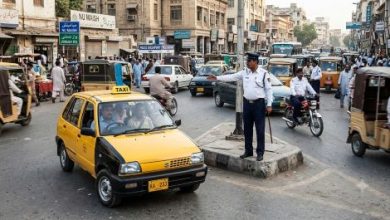
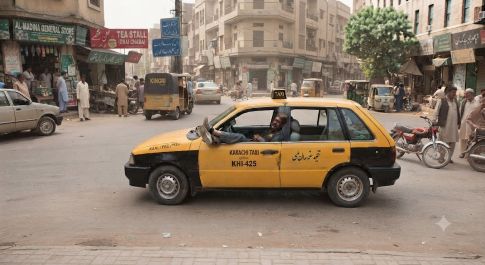
Stepping outside the Karachi Theosophical Society gates, I spotted a weathered yellow taxi idling near the towering Radio Pakistan Building. I crossed the chaotic flow of M.A. Jinnah Road and knocked sharply on the driver’s window, disturbing an elderly man resting inside.
Startled, the driver blinked awake and instantly recognized a fare. He cranked the glass downward, gesturing with a sweeping palm toward the back seat. I slid inside.
“Gulshan,” I stated.
Without uttering a single sound, the man nodded once, gripped the steering wheel, and swung the vehicle back onto M.A. Jinnah Road.
Heavy silence filled the cabin.
“You look exhausted,” I observed.
“Yes, I am,” he sighed.
“Do you work night shifts?”
“No.”
“Then what causes this exhaustion?”
“I train students at a driving academy, and my shifts begin before dawn,” he explained.
“How does that work?”
“Four instructors manage the academy. Morning checks consume my earliest hours.”
“What checks?”
“A lengthy checklist exists, but crucial steps come first.”
“Name them,” I urged.
Pausing briefly, the veteran driver continued, “A good driver always parks the car facing outward at home or the office. That simple habit saves precious minutes every morning. Second, ensure all exterior lights and indicators remain switched off.”
“What follows?”
“Before cranking the ignition, walk completely around the vehicle. Inspect tire tread depth and check tire pressure.”
“That completes the first set?”
“Correct.”
“What constitutes the second set of instructions?”
“Lift the engine bonnet. Verify oil levels, brake fluid status, radiator coolant, and battery water.”
“Where did you acquire such discipline?”
“Experience,” he replied simply. “Years ago, I drove heavy transport for an oil exploration company deep in the Kirthar Range.”
“You learned everything there?”
“Indeed,” he affirmed with a slow nod.
“People talk constantly about good drivers. Tell me about the bad ones.”
Chuckling softly, he kept his gaze fixed straight ahead on the pavement. “The list of bad driving habits exceeds the good ones.”
“Share a few.”
“Poor parkers are bad drivers. They frustrate everyone. They shift back and forth three times, and they never utilize side mirrors and rear windows to finish the job efficiently.”
“What final advice do you offer motorists?”
“Machines demand respect and regular maintenance. Treat your car like a loyal companion. Invest proper attention, and peace of mind returns the favor. A well-maintained vehicle never fails during critical moments.”
“One final question. Society often claims women make terrible drivers. Is that accurate?”
“False,” he countered firmly. “Driving success depends entirely on situational awareness—comprehending the immediate road network, merging traffic, peak hours, and surrounding obstacles. Gender matters far less than geographic awareness. Give women more space and public opportunity, and they excel.”
He paused, gripping the wheel tighter. “Machines possess no gender bias. Car technology and mechanical parts do not favor men or create mechanical failures specifically for women. Society shapes how women receive training and how public perception views them.”
Grateful for his practical maintenance wisdom and his progressive perspective on women drivers, I adjusted my seat.
“Please drop me at the NIPA crossing instead,” I requested.
He delivered me smoothly to the destination, and I handed over the agreed fare.
____________________
 Dr. Zaffar Junejo has a Ph.D in History from the University of Malaya. His areas of interest are post-colonial history, social history and peasants’ history. He may be reached at junejozi@gmail.com